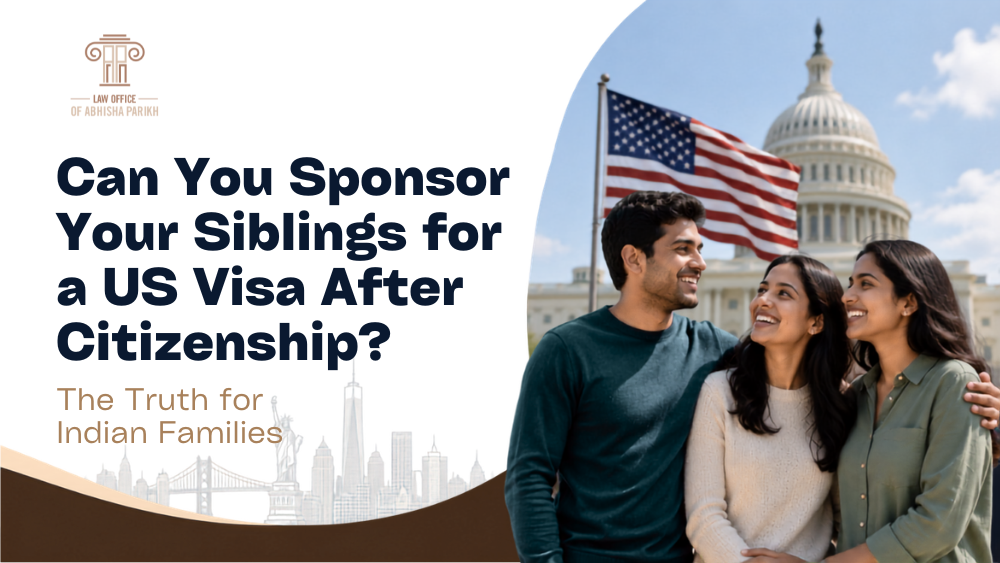
Can You Sponsor Your Siblings for a US Visa After Citizenship? The Truth for Indian Families
Becoming a U.S. citizen is a milestone that changes everything, including what you can do for the people you left behind.
For many Indian-Americans, naturalization is not just a personal achievement. It is the moment the clock starts on a much older promise: bringing your family here. And for those with brothers and sisters still in India, the first question is almost always the same. Can I sponsor my siblings for a US visa now that I am a citizen?
The short answer is yes. The complete answer is far more important.
What most newly naturalized citizens are never told, by family, by community members, or even by well-meaning advisors, is that the sibling visa process is one of the most complex and misunderstood pathways in U.S. immigration law. It exists. It works. But it operates under conditions that catch most Indian families completely off guard.
The wait times are not months. The filing errors are not minor. And the decisions you make in the first few weeks after naturalization can affect your sibling’s timeline by years.
This article gives you what the generic guides leave out: a clear, honest picture of how sibling sponsorship actually works for Indian families, what the process truly costs in time and preparation, and exactly what to do from the moment you are ready to file.
If you are serious about sponsoring your siblings, the best time to understand this process was yesterday. The second best time is right now.
Why Sponsoring a Sibling Is More Complicated Than You Have Been Told
The moment you receive your Certificate of Naturalization, something shifts. The questions start coming from your parents, your siblings, your extended family, and the assumption underneath all of them is the same: now that you are a citizen, you can bring us here.
That assumption is not wrong. But it is dangerously incomplete.
Here is the root problem most Indian families face: they receive a true fact, that U.S. citizens can petition for siblings, without receiving the full context that makes that fact meaningful. And acting on half the truth in immigration is often worse than not acting at all.
The Category No One Explains Properly
When a U.S. citizen files to sponsor a brother or sister, that petition falls under what is called the F-4 family preference category, the fourth and final tier of the U.S. family-based immigration system. There are four preference categories in total, and F-4 sits at the bottom of the priority ladder.
That placement matters enormously. It means siblings compete for the fewest available visa numbers, behind married children of citizens, unmarried adult children of citizens, and married children of green card holders. It means the line is longer, the movement is slower, and the demand from countries like India makes it slower still.
Most people filing to sponsor a US citizen brother or sister do not learn any of this until after they have already filed, or worse, after they have already told their sibling to start making plans.
The Expert Insight Most Advisors Skip
Here is what separates informed petitioners from everyone else: the I-130 petition you file today does not get your sibling a visa. It gets your sibling a place in line.
Those are two entirely different things, and the gap between them for Indian nationals specifically is measured not in months but in decades.
The families who navigate this process well are not the ones who filed fastest or asked the most questions in community forums. They are the ones who understood the structure of the system before they engaged with it, who knew that filing early, filing correctly, and setting realistic expectations would determine everything that followed.
The India-Specific Backlog: What No One Tells You About the F-4 Wait Time
Most people who research sibling sponsorship find the same basic answer: yes, it takes a long time. What they almost never find is why it takes so much longer for Indian families specifically, and what that difference actually means in practice.
Per-Country Caps Create an Unequal System
The United States issues a fixed number of family-based visas each year. Within that total, each preference category, including F-4 for siblings, receives a set allocation. But here is the part most guides leave out entirely: no single country can receive more than 7% of the total family-based visa numbers available in any given year.
That cap applies equally to every country, regardless of population size or demand.
For a country like India, with well over a billion people and one of the largest immigrant populations in the United States, this creates a structural bottleneck that has no equivalent among other nationalities. A sibling petitioner from a low-demand country might wait a few years for an F-4 visa. An Indian petitioner filing that same petition today could wait several decades.
This is not speculation. The U.S. Department of State Visa Bulletin, published monthly, tracks the current priority dates for each visa category by country. The India F-4 cutoff dates reflect a backlog that stretches back many years, meaning applications filed long ago are only now approaching the front of the line.
Why This Matters More Than the Wait Itself
For Indian families trying to sponsor a US citizen sibling, the wait time is not just an inconvenience. It reshapes life decisions on both sides of the ocean.
Siblings in India make career choices, marriage decisions, and long-term plans under a shadow of uncertainty that can last a generation. Meanwhile, the petitioner in the U.S. carries the quiet weight of a promise made in good faith but that cannot be controlled on a fixed timeline.
Understanding this dynamic early, before the I-130 is filed and before expectations are set within the family, is one of the most important things a newly naturalized citizen can do. It does not change the timeline. But it changes how you prepare for it, communicate about it, and protect against the mistakes that make an already long wait even longer.
What Happens If You Wait, File Wrong, or Do Not Understand the Rules
Given the decades-long timeline already built into the F-4 sibling visa process, there is almost no margin for error. Every avoidable mistake, a delayed filing, an incomplete form, a misunderstood instruction, compounds an already difficult situation. For Indian families specifically, the consequences are not abstract. They are measured in years of a sibling’s life.
The Cost of Filing Late
Consider this scenario: Rajan becomes a U.S. citizen in 2025. He hears from a cousin that there is no rush because the wait is so long anyway. He waits eighteen months before filing the I-130 for his sister in Hyderabad.
Those eighteen months are gone permanently. In the F-4 India backlog, a priority date is everything. The date USCIS receives your petition is the date your sibling’s place in line is established, and that date cannot be backdated, amended, or recovered. Filing late does not just delay the process. It mathematically extends how long your sibling waits on the other end.
The Cost of Filing Incorrectly
Financial: A rejected or returned I-130 means refiled fees, additional documentation costs, and in some cases legal fees to untangle errors made without proper guidance. The dollar amounts may feel manageable in the moment, but the compounding timeline cost is not.
Legal: Errors on immigration petitions can trigger Requests for Evidence that stall the case for months. In more serious situations, misrepresentations, even unintentional ones, can create complications that follow a petition for years.
Emotional: Few things damage family trust more than a sibling who waited patiently for years, only to learn that the petition was filed incorrectly or that expectations were set without accurate information. The person who sponsored them carries that weight.
The Long-Term Risk Most People Never Consider
What happens if the petitioner passes away before the sibling’s visa becomes available? Given F-4 India wait times, this is not an edge case. It is a real planning consideration. Petitions can survive the petitioner’s death under specific circumstances, but only if they were properly filed and actively managed. An improperly maintained petition may not survive at all.
The families who successfully sponsor siblings for a US visa do so because they treated the process with the same seriousness they would give any major long-term commitment, because that is exactly what it is.
How to Sponsor Your Sibling for a US Visa: A Step-by-Step Framework for Indian Families
The sibling sponsorship process is long, but it is not complicated if you understand the structure before you begin. What follows is a clear framework built around the six phases every petition must move through, and the decisions that matter most at each one.
Step 1: Confirm You Actually Qualify to File
Before anything else, three conditions must be true. You must be a U.S. citizen, not a green card holder, as permanent residents cannot petition for siblings under any category. You must be at least 21 years old. And you and your sibling must share at least one biological or legally adoptive parent.
If all three apply, you can file. If you are not yet a citizen, the time to plan is now.
Step 2: File Form I-130 Immediately After Naturalization
The I-130, Petition for Alien Relative, is the document that formally establishes your sibling’s place in line. File it as soon as possible after you naturalize. The date USCIS receives this form becomes your sibling’s priority date, and that date is the single most important number in this entire process.
Do not wait until you feel ready. Do not wait until your sibling decides they definitely want to come. File first. Decisions can be made later. A priority date cannot be recovered once lost.
The USCIS I-130 petition page outlines exactly what documentation is required, including proof of your citizenship, birth certificates establishing the shared-parent relationship, and the current filing fee.
Step 3: Understand What “Approved” Actually Means
An approved I-130 is not a visa. It is confirmation that your relationship qualifies and that your sibling is now formally in the queue. After approval, USCIS transfers the petition to the National Visa Center, where it waits, sometimes for many years, until a visa number becomes available.
Step 4: Monitor the Visa Bulletin Every Month
The State Department publishes a monthly Visa Bulletin that controls when active processing can begin. When your sibling’s priority date becomes current, the next phase starts. Until then, your most important job is to watch, wait, and keep your contact information updated with the NVC.
Step 5: Complete NVC Processing and Prepare for the Consular Interview
When a visa number is available, the NVC will request financial documents, civil records, and fees. Once those are submitted and reviewed, a consular interview is scheduled, typically at the U.S. Embassy in Mumbai for Indian applicants. A successful interview results in an immigrant visa and lawful permanent resident status upon entry.
What to Avoid at Every Stage
Using unlicensed immigration consultants or community notarios to prepare the petition is one of the most common and costly mistakes in this process. Errors in petitions they prepare often go undetected until USCIS issues a Request for Evidence or rejects the filing outright. Other mistakes to avoid include filing without a complete understanding of document requirements, assuming the process is moving without receiving confirmation, and failing to notify USCIS or the NVC of address or contact changes over the years.
What Success Actually Looks Like When You Sponsor Your Sibling the Right Way
The goal of this process is not just a visa. It is certainty, for you, for your sibling, and for the family relationship that has stretched across two countries, sometimes for decades. What separates the families who achieve that certainty from those who do not is rarely luck. It is almost always preparation.
The Strong Outcome: What It Looks Like in Practice
Imagine this: Meera naturalizes in early 2025. Within weeks, she files a properly prepared I-130 for her younger brother in Pune. She understands the wait will be long, but she also knows that her brother now has a priority date, a formal place in line, and a petition that was done correctly from the start.
Her brother knows what to expect. He does not make major life decisions in the dark. The family has a shared, realistic understanding of the timeline. There are no false promises and no devastating surprises.
Years from now, when his priority date becomes current, the NVC process moves efficiently because the foundational paperwork was accurate. The consular interview in Mumbai goes smoothly because nothing was hidden, omitted, or filed incorrectly years earlier. He enters the United States as a lawful permanent resident, and Meera can say, without reservation, that she did everything within her power to make it happen.
That is what it means to successfully sponsor a sibling for a US visa after becoming a citizen. Not speed, the system does not allow for that, but control, clarity, and the quiet confidence of knowing the process was handled with the seriousness it deserved.
The Contrast: What Avoidable Mistakes Actually Cost
Compare Meera’s experience with a family that waited two years to file, used a non-attorney to prepare the petition, and never tracked the Visa Bulletin. When errors surfaced years later, the correction process cost them time they could never recover and trust within the family that took even longer to rebuild.
According to research published by the Migration Policy Institute, family-based immigration backlogs disproportionately affect high-demand countries like India, making early, accurate filing not just advisable but essential for any realistic outcome.
The Difference No One Talks About
There is a version of this process where you spend the next two decades wondering if you did it right. And there is a version where you know you did.
The preparation you put in today determines which version becomes yours.
Frequently Asked Questions: Sponsoring a Sibling for a US Visa After Becoming a Citizen
What documents do I need to sponsor my brother or sister for a US visa?
The core documents required to file an I-130 petition for a sibling include proof of your U.S. citizenship, birth certificates for both you and your sibling that establish a shared parent, a government-issued photo ID, and the current filing fee. If the shared parent is not the biological parent of both siblings, such as in cases of adoption or blended families, additional documentation will be required to establish the legal relationship. Accuracy and completeness matter enormously here, because errors or omissions are among the leading causes of delays, Requests for Evidence, and rejections that reset the process.
Can I include my sibling’s spouse and children in the petition?
Yes. When you sponsor a sibling for a US visa under the F-4 category, their spouse and unmarried children under 21 can be included as derivative beneficiaries on the same petition. This means they share the same priority date and move through the process together, rather than requiring separate petitions. However, children who turn 21 before the visa becomes available may age out of derivative status, which is a real risk given the length of F-4 India wait times. Planning for this possibility, and understanding the protections available under the Child Status Protection Act, is an important part of managing a long-term sibling petition.
Can I sponsor more than one sibling at the same time?
Yes. U.S. citizens can file separate I-130 petitions for multiple siblings simultaneously. Each sibling requires their own individual petition and establishes their own independent priority date based on when their petition is received. Filing for multiple siblings at the same time, rather than sequentially, ensures that each one enters the queue as early as possible. Staggering filings creates significant differences in wait times between siblings, which can become a source of family tension over the years that follow.
Does becoming a US citizen automatically start the process of bringing my sibling here?
No. Naturalization gives you the legal right to petition for a sibling, but nothing happens automatically. You must actively file the I-130 petition to initiate the process and establish a priority date. Many newly naturalized citizens assume that citizenship itself triggers some kind of immigration benefit for their family members. It does not. The right exists, but exercising it requires deliberate, timely action. For Indian families who want to sponsor siblings for a US visa, the process begins the moment you decide to file, and every day of delay is a day that cannot be recovered at the other end of a very long wait.
The Right Move Is the One You Make Today
Becoming a U.S. citizen is one of the most significant legal milestones of your life. For many Indian-Americans, it is also the moment a long-held family obligation finally becomes actionable.
Good intentions without accurate information lead to avoidable mistakes, and in the F-4 sibling visa process, avoidable mistakes are measured in years, not months.
The truth about how to sponsor your siblings for a US visa after becoming a citizen is not complicated once you understand it clearly. The category exists. The process works. But it rewards those who file early, prepare correctly, and go into it with honest expectations about what the timeline actually looks like for Indian nationals.
The families who handle this well are the ones who asked the right questions at the right time, before they filed, before they made promises to their siblings, and before small errors had years to compound into serious consequences.
You now have a clearer picture than most people get before they start this process. The question is what you do with it.
If you are a U.S. citizen thinking about sponsoring a sibling, or if you have already filed and are uncertain whether it was done correctly, speaking with an experienced immigration attorney costs far less than discovering a problem years from now. At the Law Office of Abhisha Parikh, we welcome these conversations. Reach out for a confidential consultation, and let us make sure your family’s process starts, or continues, on solid ground.