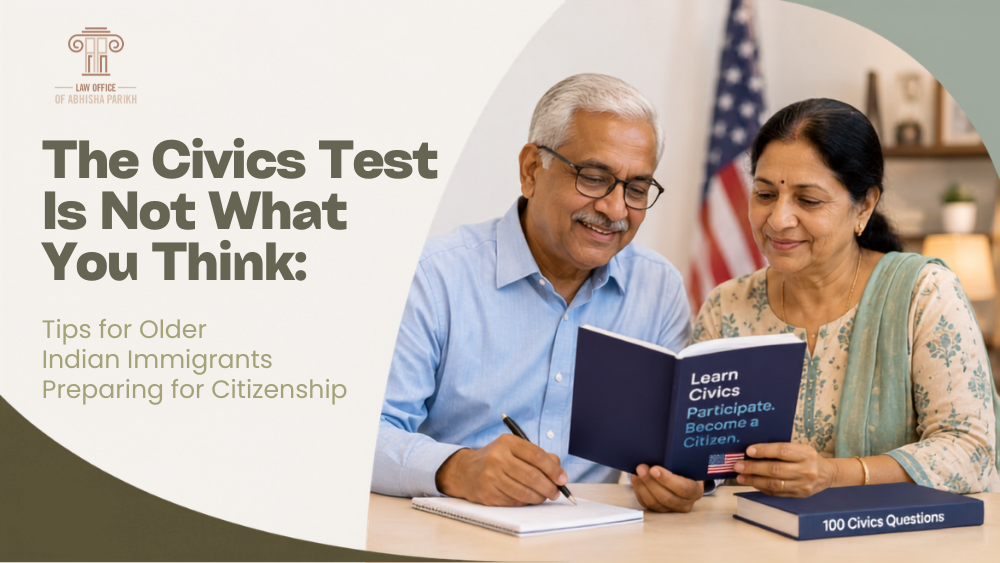
The Civics Test Is Not What You Think: Tips for Older Indian Immigrants Preparing for Citizenship
You Have Waited Decades for This. Do Not Let the Civics Test Stop You Now.
You spent years, maybe twenty, maybe more, waiting for your Green Card. You built a career here, raised children here, planted roots so deep that America stopped feeling like a destination and started feeling like home.
Now citizenship is within reach. And then someone mentions the civics test, and everything slows down.
For older Indian immigrants preparing for the citizenship civics test, this is the moment where the process quietly stalls. The test itself is manageable. The myths surrounding it are what cause the delay.
Most people imagine a formal exam. A room full of questions about American history. English they may feel uncertain speaking under pressure. What most applicants discover only after speaking with an attorney is that the civics test for naturalization is ten questions, asked conversationally, in an office. Qualifying long-term residents can take it in their native language.
That changes everything.
This article breaks down exactly what the civics test requires, which exemptions apply to older applicants, what the real risks are when people walk in underprepared, and how to approach the entire naturalization process with clarity instead of anxiety.
If the civics test has been the reason you have filed your N-400 yet, keep reading. The path forward is clearer than you think.
Why So Many Long-Term Indian Residents Delay Citizenship and Why the Civics Test Gets the Blame
Most people who delay naturalization will say the same thing: “I am just not ready for the civics test.” It sounds reasonable. It feels true. In most cases, it is a problem with a straightforward solution.
The Test They Are Imagining Is Different From the Real One
When older Indian immigrants picture the citizenship civics test, they picture something far more formal than what actually takes place. A written exam. A long list of questions about American presidents and constitutional amendments. A formal setting where imperfect English becomes a liability. A moment of pressure after a lifetime of professional accomplishment.
The naturalization civics test is a conversation. A USCIS officer asks up to ten questions from the published list of 100. The applicant answers six correctly and passes. There is no written component. There is no audience. It happens inside a regular office, as part of a longer interview, in a tone much closer to a discussion than a formal examination.
The gap between what people fear and what actually occurs is where delay lives.
The Blind Spot That Keeps Educated People Stuck
The applicants who delay the longest are often among the most accomplished. Engineers. Physicians. Business owners. People who navigated the EB-2 and EB-3 process, survived retrogression, managed H-1B transfers, and built stable lives in a country where nothing about their immigration status was ever simple.
These are people who handle complexity well. The issue is that they were never given accurate, complete information about what citizenship test preparation for Indian green card holders actually involves.
And so they wait. Another year. Another trip to India. Another reason to postpone.
The Expert Insight Most People Miss
The civics requirement is a flexible standard shaped directly by your age and years of permanent residency. Those two factors change what is required of you, including whether you may take the exam entirely in your native language.
That single fact, unknown to the majority of eligible applicants, is why so many long-term residents preparing for the naturalization test are delaying a process they are fully prepared to complete.
The Rule Most People Never Hear About: The 65/20 Exemption and the Native Language Option
There is a provision built directly into the naturalization process that changes everything for older long-term residents. The vast majority of eligible applicants have never heard of it.
It is published by USCIS. It has been part of the naturalization framework for years. And it remains one of the most consistently overlooked factors in citizenship planning for older Indian immigrants preparing for the civics test.
Two Exemptions. Two Very Different Experiences.
The first is the 50/20 rule. If you are 50 years of age or older and have held your Green Card for at least 20 years, you are exempt from the English language requirement. You may bring a qualified interpreter to your naturalization interview and take the civics portion entirely in your native language, whether that is Hindi, Gujarati, Telugu, Tamil, Punjabi, or any other language you speak with confidence.
The second is the 65/20 rule. If you are 65 or older and have been a lawful permanent resident for at least 20 years, the accommodations go further. You may take the civics test in your native language, and USCIS reduces the study pool from 100 questions to a designated set of 20. Your officer will ask up to 10 questions drawn from those 20. You need to answer 6 correctly to pass.
According to USCIS, both of these accommodations must be indicated when filing the N-400. They are not automatically applied at the interview.
Why This Changes the Entire Conversation
Consider what this means in practice. A 67-year-old woman from Ahmedabad who received her Green Card in 2003 and is applying for citizenship today qualifies for the 65/20 exemption. She studies 20 questions in Gujarati, answers 6 of 10 correctly, and passes.
That is the law, written specifically for people in her situation.
The reason so many older Indian immigrants preparing for the citizenship civics test are unaware of this is straightforward. It was not explained at their Green Card interview. It was not shared by the employer or family member who first helped them navigate the system. An immigration attorney who specializes in naturalization will identify this eligibility in the first consultation. Applicants arriving without counsel often find out after they have already studied the wrong material for months.
What Happens If You Wait, File Without Guidance, or Walk In Underprepared
Delay feels safe. The costs accumulate quietly.
For long-term Indian permanent residents who have already navigated one of the most difficult immigration backlogs in the world, postponing the final step can feel like a reasonable pause. The costs of waiting and the risks of walking into a naturalization interview underprepared are more concrete than most people realize.
The Cost of Another Year Without Citizenship
Every year spent as a permanent resident rather than a citizen is a year without a U.S. passport, without the right to vote, and without the ability to petition for parents or siblings at the citizen level, which carries meaningfully faster processing than LPR-based petitions.
For older Indian immigrants preparing for the citizenship civics test, this delay often has a direct family consequence. If your mother or father is aging in India and you are waiting to petition for them until after you naturalize, each year of delay adds to an already long reunification timeline. That is a parent growing older an ocean away.
The Financial and Legal Risk of Undisclosed Travel
Many long-term Indian LPRs make extended trips to India to care for aging parents, attend family events, or manage property. Trips lasting six months or more can interrupt the continuous residence requirement for naturalization. If this travel history is undocumented or unexplained, it can delay or complicate an otherwise straightforward N-400.
Applicants who self-file without legal guidance frequently omit or mischaracterize travel history, often out of genuine confusion about what matters. USCIS reviews this carefully. That triggers requests for additional evidence, extended processing times, and in more serious cases, denial.
The Emotional Cost of Walking In Underprepared
Walking into a federal interview without knowing which questions you will be asked, whether you qualify to use an interpreter, or whether your travel history raises a concern creates real distress for people who have spent decades doing everything correctly.
Applicants who are unsuccessful at the civics test at their first interview must wait 60 to 90 days for a second attempt. That is two to three additional months of uncertainty and rescheduling for something that proper preparation would have prevented.
The Long-Term Consequence Worth Naming Directly
For older Indian immigrants, delaying naturalization also delays the ability to sponsor family members, limits travel flexibility, and removes full participation in the civic life of the country that has been home for decades.
The naturalization civics test requirement is structured and manageable. Walking in without knowing your rights is the part that creates unnecessary difficulty.
How to Prepare for the Citizenship Civics Test as an Older Indian Immigrant: A Step-by-Step Framework
The naturalization process rewards preparation and penalizes assumptions. For older Indian immigrants who have held a Green Card for years, often decades, the path to citizenship is more structured and more navigable than it appears from the outside.
Step 1: Determine Which Version of the Test Applies to You
Before studying a single question, establish your eligibility category. This determines everything that follows.
Standard applicant: Under 50, or fewer than 20 years as a permanent resident. Full 100-question pool. English required.
50/20 rule: Age 50 or older with 20 or more years as an LPR. Full 100-question pool, with the option to take the civics test in your native language using a qualified interpreter.
65/20 rule: Age 65 or older with 20 or more years as an LPR. Reduced pool of 20 designated questions. Native language permitted. This is the most significant accommodation available to older applicants.
Studying the wrong material wastes months of preparation time. Start here.
Step 2: Mark Your Accommodation Request on the N-400
If you qualify for the 50/20 or 65/20 exemption, indicate your interpreter need directly on the N-400 application. This does not happen automatically at the interview. Your interpreter cannot be your attorney or an immediate family member, and they must interpret accurately in both directions.
Arrange this before you file, not after you receive your interview notice.
Step 3: Study the Correct Question Set
If you qualify for the 65/20 exemption, USCIS publishes the specific set of 20 questions your interview will draw from. Study those 20. The American Immigration Council provides helpful orientation resources on what the broader naturalization process involves and what to expect throughout.
You need to answer 6 of 10 correctly to pass, regardless of which pool applies to you.
Step 4: Address Your Travel History Before You File
Review every trip outside the United States in the past five years, including length, destination, and purpose. Any absence of six months or more requires a clear explanation. Absences of one year or more carry more serious implications for continuous residence. Gather documentation showing your intent to maintain a U.S. domicile during those trips: tax returns, property records, employment records, and utility bills.
This is where applicants who self-file most often create unintentional complications.
Step 5: Prepare for the Full Interview, Not Just the Civics Portion
The civics test for older immigrants preparing for citizenship is one component of a longer interview. The officer will also review your N-400 line by line, ask about your background and travel history, and assess your eligibility based on good moral character. Bring original documents organized by category. Review every answer you submitted on your application before your appointment.
Step 6: Consider a Legal Review Before You File
If you have extended travel history to India, any prior immigration complications, a criminal record of any kind, or uncertainty about your eligibility category, a consultation with an experienced immigration attorney before filing is practical risk management. One corrected mistake before filing protects your timeline and your application.
What It Actually Feels Like to Complete This Process the Right Way
There are two versions of the naturalization experience for older Indian immigrants preparing for the citizenship civics test. They begin in the same place: decades of waiting, a Green Card finally in hand, and a decision about whether to take the final step. Where they end depends almost entirely on preparation.
The Strong Outcome: What It Looks Like When This Goes Right
Sunita came to the United States in 1999 on an H-4 visa, her status tied to her husband’s employer sponsorship. She waited through years of retrogression, raised two children here, and received her Green Card in 2018. In 2025, she consulted an immigration attorney before filing her N-400.
In that consultation, she learned three things she had not previously known. First, she qualified for the 65/20 exemption based on her age and total years of lawful residence. Second, she could bring a Gujarati interpreter. Third, her two extended trips to India during the pandemic, each just under six months, needed proper documentation to support her continuous residence record.
Her attorney helped her prepare. She studied the correct 20 questions in Gujarati. She organized her travel records. She walked into her interview knowing exactly what to expect.
She answered 7 of 10 questions correctly on her first attempt. Eight weeks later, she raised her right hand at a naturalization ceremony in Newark. The following month, she filed an I-130 petition for her mother in India.
That is what a strong outcome looks like: no surprises, no failed attempts, no rescheduling, and a clear next step already in motion.
The Outcome That Preparation Prevents
Applicants who self-file without legal review, study all 100 questions in English when they qualified for a native language exemption, or walk in without addressing a six-month gap in continuous residence face concrete setbacks: failed civics tests, requests for additional evidence, processing delays of six months to a year, and in some cases, denial on continuous residence grounds that proper documentation would have resolved.
According to data tracked by the National Partnership for New Americans, preparation and access to legal assistance are among the strongest predictors of naturalization success, particularly for older applicants and those with limited English proficiency.
The Outcome This Avatar Actually Wants
For long-term Indian permanent residents, the ideal outcome extends well beyond a certificate. It is a U.S. passport. It is travel to India with the confidence of returning as a citizen. It is the ability to petition for a parent who is aging in Mumbai or Hyderabad. It is the permanent, settled knowledge that your place in this country belongs to you entirely.
That outcome is achievable. It is also more accessible than most older applicants realize, once someone explains the rules that were always written for them.
Frequently Asked Questions: The Civics Test for Older Indian Immigrants Preparing for U.S. Citizenship
1. What exactly is the civics test for U.S. citizenship, and how hard is it?
The civics test is a spoken portion of your naturalization interview where a USCIS officer asks you 20 questions drawn from a published list of 128. You need to answer 12 correctly to pass. There is no written exam, no time limit, and no formal test setting. It takes place during a regular office interview, in a conversational format. For most well-prepared applicants, it is far less intimidating than they expected. The difficulty is almost always in the anticipation, not the room itself.
2. Do older immigrants have to take the full civics test to become a U.S. citizen?
Older long-term residents have access to meaningful accommodations that reduce what the test requires of them. If you are 50 or older with at least 20 years as a permanent resident, you may take the civics test in your native language. If you are 65 or older with 20 or more years as an LPR, the 65/20 exemption applies: a reduced pool of 20 questions and a native language interpreter. These are written provisions available to anyone who qualifies and requests them properly when filing the N-400.
3. What is the 65/20 rule for the citizenship civics test, and do I qualify?
The 65/20 rule is a USCIS accommodation for naturalization applicants who are 65 years of age or older and have been lawful permanent residents for at least 20 years. Qualifying applicants are tested on only 20 designated civics questions, may use a native language interpreter, and are also exempt from the English reading and writing requirements. If you fit this profile, the test is structured to reflect your circumstances specifically. You claim this accommodation by indicating it on your N-400 at the time of filing.
4. What happens if I am unsuccessful at the civics test at my naturalization interview?
A first-attempt result that does not meet the passing threshold does not end your application. USCIS will schedule a second interview within 60 to 90 days, where you will be retested only on the portions you did not pass. If the second attempt also results in a denial, your N-400 application will be denied, though you may re-file. Most first-attempt difficulties come down to inadequate preparation or studying the wrong question set, both of which are entirely preventable with proper guidance before the interview.
5. Does traveling to India affect my eligibility for citizenship?
Extended travel to India is one of the most common and least discussed risks in the naturalization process for older Indian immigrants. Absences of six months or more can interrupt the continuous residence requirement that USCIS uses to determine eligibility. Absences of one year or more create a situation that requires substantial documentation to address. If you have taken long trips to India to care for aging parents or manage family affairs, reviewing and documenting that travel carefully before filing your N-400 is an important step, ideally with an attorney who can assess whether it affects your application.
6. What documents do I need to bring to my N-400 naturalization interview?
At minimum, bring your Green Card, a government-issued photo ID, your passport showing all international travel for the past five years, and any documents related to previous immigration filings. If you have been married, divorced, or widowed, bring the relevant certificates. If you have ever been arrested or cited, bring the court disposition records. If you are using an interpreter, bring their identification and confirm they are prepared to interpret in both directions. Organizing your documents in advance, indexed and tabbed, removes one more source of stress from a significant appointment.
7. Should I hire an immigration attorney to help me prepare for the civics test and naturalization interview?
For straightforward cases with clear eligibility and a clean travel history, many applicants self-file successfully using USCIS official resources. For older Indian immigrants who have made extended trips to India, have any gaps in employment or tax history, or are uncertain about their continuous residence record, legal guidance before filing is practical protection. An attorney will confirm which exemption category applies, ensure the N-400 is filed correctly, and prepare you for the full interview. One corrected mistake before filing is worth far more than addressing it after the fact.
The Civics Test Was Never the Obstacle. Not Knowing Your Rights Was.
You have already done the hard part.
You navigated a backlog that stretched across decades. You maintained your status through job changes, family transitions, and years of uncertainty that most people will never fully understand. You built a life here, completely, carefully, and with enormous patience.
The final step deserves to be completed with the same care.
For older Indian immigrants preparing for the citizenship civics test, the most important shift is this: the test you have been dreading is structured to accommodate people exactly like you. The rules written for long-term permanent residents are more flexible and more accessible than almost anyone explains before you think to ask.
Staying in uncertainty carries a real cost. Another year without a U.S. passport. Another year before you can petition for a parent. Another year of re-entry anxiety every time you return from India.
Moving forward with accurate information and a clear preparation strategy costs far less in time, in stress, and in risk than most people expect.
If the civics test, your travel history, or uncertainty about your eligibility has kept you from filing your N-400, the right next step is a single conversation with an experienced immigration attorney. At the Law Office of Abhisha Parikh, we work with long-term permanent residents every day who are closer to citizenship than they realize. We will review your situation, confirm your exemption eligibility, and give you a clear picture of what your path actually looks like. That clarity is closer than you think.