Being a crime victim is already one of the hardest things a person can go through. When your immigration status is uncertain, on top of that, the fear of doing anything: reporting the crime, asking for help, or even looking things up online, can feel paralyzing.
What many people do not know is that U.S. immigration law includes a specific protection built for this exact situation, known as the U Visa. It can give you temporary legal status in the USA.
The catch is that qualifying is not automatic. The requirements are detailed, the process takes time, and some parts of it are genuinely complicated. At the Law Office of Abhisha Parikh, we work with clients navigating exactly this situation. This post walks through who actually qualifies, what tends to trip people up, and the moments where having a U Visa lawyer in your corner stops being optional.
What is a U Visa?
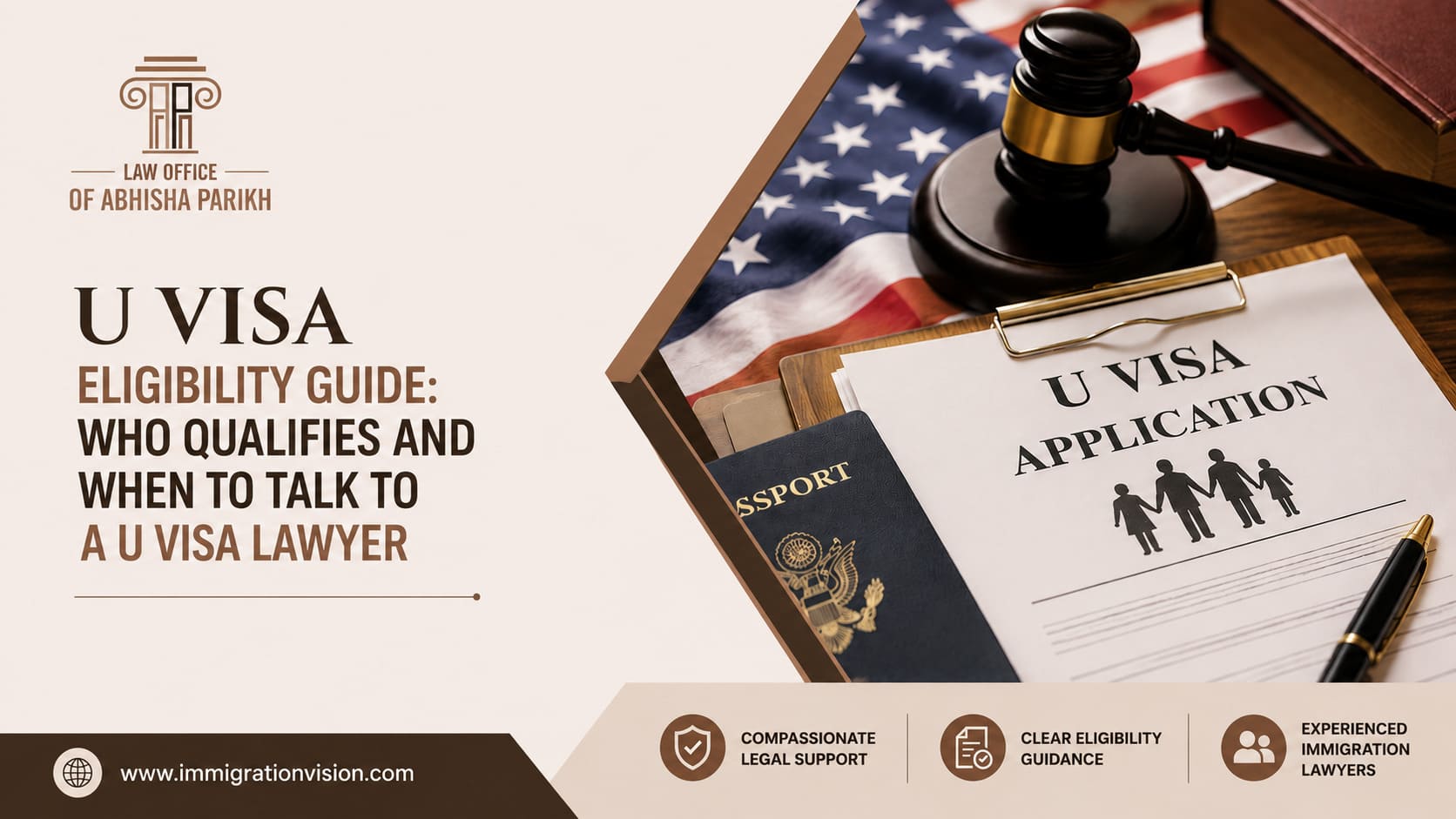
The U Visa is a nonimmigrant visa created for non-citizens who have been victims of certain crimes in the United States and are willing to cooperate with law enforcement. It was designed to remove an unfair trade-off: no one should have to choose between reporting a crime and protecting their immigration status.
If approved, a U Visa provides temporary legal status for up to 4 years, work authorization, and, for eligible applicants, a pathway to permanent residency after 3 years of continuous U Visa status.
What Are the Core U Visa Eligibility Requirements?
There are four things USCIS looks at when reviewing a U Visa petition. You need to satisfy all four — not just most of them.
1. You were the victim of a qualifying crime
The crime must have occurred in the United States or violated a U.S. law. Not every offense qualifies, but the list covers a wide range of situations. We will get into the specifics in the next section.
2. You suffered substantial physical or mental abuse
This does not mean your injuries had to be visible or severe enough for a hospital visit. Documented anxiety, PTSD, depression, and ongoing emotional harm have all been recognized as meeting this standard. What matters is that the abuse was real, connected to the crime, and supported by some form of evidence.
3. You have information about the crime and have cooperated — or are willing to
You do not need to testify in court or push for a prosecution. Providing a statement to police, cooperating early in an investigation, or even being willing to assist going forward can satisfy this requirement. The essential word here is cooperation; USCIS wants to see that you were not completely absent from the process.
4. You are admissible to the United States, or you can get a waiver
This is where things get complicated for many people. Past immigration violations, prior entries without authorization, or certain criminal history on your record do not automatically disqualify you, but they do mean you will likely need to file a separate waiver. That waiver is its own significant undertaking, and it almost always requires legal help to do correctly.
Which Crimes Actually Qualify for a U Visa?
More than most people would expect. The qualifying crimes span several categories:
- Violent crimes: Domestic violence, rape, sexual assault, felonious assault, murder, torture, kidnapping
- Exploitation and control: Trafficking, involuntary servitude, slave trade, peonage
- Coercion-based crimes: Stalking, blackmail, extortion, obstruction of justice, witness tampering
- Other federal offenses: Incest, female genital mutilation, fraud in foreign labor contracting, and abusive sexual contact
One thing worth knowing: crimes “of a similar nature” to those on the official list of qualifying criminal activities can also qualify under certain circumstances. That assessment is not always straightforward. If your situation involves a crime that does not appear on this list but feels like it should, that question alone is worth bringing to an attorney.
The Part Nobody Tells You About: Law Enforcement Certification
Even if your case checks every other box, you cannot file a complete U Visa application without a signed Form I-918, Supplement B — a law enforcement certification.
This form has to come from a qualifying agency. That might be the police department that handled your case, a prosecutor’s office, a federal agency, or sometimes a judge. Whoever signs it is confirming that you were a victim of a qualifying crime and that you were, are, or are likely to be helpful in the investigation or prosecution.
Here is the part that frustrates many applicants: agencies are not legally required to sign. Some do it routinely. Others are slow, reluctant, or never respond. And once you do get a signed certification, the clock starts. You have 6 months from the date it is signed to submit your full petition. Miss that window, and you are starting over.
That six-month deadline is one of the main reasons people benefit from having legal help before they even approach law enforcement for certification, not after.
When Does Having a U Visa Lawyer Actually Matter?
Not every U Visa case needs an attorney. But there are situations where the risk of going alone is genuinely high.
Law enforcement is not responding.
Some police departments are cooperative. Others are not, and most applicants have no idea how to push back on that. Attorneys know how to approach agencies, clearly frame the legal standard, and escalate when local contacts are unresponsive. This is not something most people can manage effectively on their own.
You need an inadmissibility waiver.
If you have a deportation order, prior immigration violations, or certain criminal history, you must obtain a waiver. Writing a compelling waiver argument involves legal analysis, not just paperwork. One incomplete or poorly framed submission can undermine an otherwise solid case.
Documenting the abuse is unclear.
The personal statement and supporting evidence you submit need to connect the crime, the harm you suffered, and your cooperation with law enforcement in a coherent, legally persuasive way. A U Visa attorney can help you think through what actually strengthens this documentation and what leaves gaps.
You are already in removal proceedings.
This is urgent. If you have a pending or approvable U Visa petition and a removal order pending, a lawyer may be able to request a stay of removal. Immigration judges have discretion to pause deportation while a bona fide petition is pending, but most people in this situation simply do not know that option exists without legal counsel.
Family members may be included.
Depending on your age at the time of filing and your relationship to certain relatives, it may be possible to include a spouse, children, or, in some cases, parents and siblings in your petition. Getting this right requires careful evaluation of each person’s situation.
Can You Apply Without a Lawyer?
You can. There is no rule requiring legal representation to file a U Visa petition.
Some applicants do go through the process independently, especially when circumstances are relatively clean — a cooperative law enforcement contact, no prior immigration issues, clear documentation. In those cases, self-filing is possible.
But U Visa cases are rarely that straightforward. USCIS does not give status updates on pending U Visa petitions the way it does for other applications. Wait times are long. If something is missing or unclear in your application, you may not find out until you receive a denial rather than a request for more evidence.
The stakes are also higher for someone without legal status. A denied application does not necessarily trigger enforcement action, but an incomplete or poorly submitted one can draw attention you were hoping to avoid. For most people, the cost of a single consultation is worth it when measured against the actual risk.
What Happens When You Reach Out to a U Visa Lawyer?
When clients first reach out to our office, many of them have never spoken with an immigration lawyer before. Especially if you are undocumented, it is natural to feel cautious about what the first conversation will look like.
Here is what you should know upfront: U Visa attorneys are bound by strict confidentiality rules. Nothing you share in a consultation can be reported to immigration enforcement. The purpose of that first meeting is simply to understand your situation and honestly assess whether the U Visa is the right path for you.
It helps to bring whatever documentation you have:
- a police report,
- medical records,
- a copy of a protective order,
even just a written timeline of what happened. You do not need everything to be perfectly organized. Part of what an attorney does in that early stage is help you figure out what exists, what is missing, and what still needs to be gathered.
You Should Not Have to Choose Between Safety and Status
The U Visa program exists because Congress made a deliberate choice: that people who have been victimized should not have to choose between reporting a crime and protecting their immigration status. That trade-off was always unfair, and the U Visa was designed to remove it.
If you were the victim of a crime and have been sitting on that situation because you were afraid of what it might mean for your status, you are not out of options. The path is not always simple, but it is there.
A confidential case evaluation with a U Visa lawyer and you’ll get a clear picture of where you stand and what your options actually are.
Ready to understand your options? Contact the Law Office of Abhisha Parikh today for a confidential case evaluation. No pressure, just answers.
FAQs Related to the U Visa
What are the basic eligibility requirements for the U Visa?
To qualify for a U Visa, a person generally must be the victim of a qualifying crime, suffer substantial physical or mental abuse, have information about the crime, and be helpful to law enforcement. Some applicants may also need to address inadmissibility issues through a waiver.
What crimes may qualify for a U Visa?
Qualifying crimes may include domestic violence, sexual assault, trafficking, kidnapping, felonious assault, stalking, and certain related offenses. Whether a specific situation qualifies often depends on the facts and how the offense is documented.
Do I need a law enforcement certification for a U Visa?
Yes, most U Visa applicants need a signed Form I-918 Supplement B from a qualifying agency. This certification helps show that the applicant was, is, or is likely to be helpful in the investigation or prosecution of the crime.
Can I apply for a U Visa without an immigration lawyer?
Yes, it is possible to apply without a lawyer. However, many people choose legal help when the case involves difficult evidence, waiver issues, delayed certification, or uncertainty about eligibility.
Can family members be included in a U Visa case?
In some situations, yes. Whether family members can be included depends largely on the applicant’s age and relationship to the qualifying relatives.
How long does the U Visa process take?
U Visa cases often take a long time because of annual caps and processing delays. Even so, submitting a complete and well-supported application from the start can help reduce avoidable setbacks.