What Documents Do You Actually Need for a K-1 Visa From India? The Complete List
Your fiancé(e) is in India. You are in the U.S. Somewhere between the engagement and the wedding, you have realized this is more than paperwork. It is the one process standing between you and the life you are trying to build together.
So you start searching for the documents for a K-1 visa from India, and the results feel like someone else wrote them for a different relationship. Generic checklists assume a dating history that looks very different from yours, and they skip over what to do when your relationship began through a family introduction, or what happens when a document issued in India needs more than an English translation to be accepted.
Here is what most of those checklists miss: USCIS is evaluating whether your documents tell a consistent, credible story about your relationship, and that distinction changes everything about how you should prepare.
This matters right now, because the I-129F petition you file today sets the tone for the entire case. A document gathered too early, translated incorrectly, or left out entirely can add months to a separation you were hoping to shorten.
This guide walks through exactly which documents you need, the timing mistakes that catch even careful couples off guard, and the framework for getting it right the first time, so the process becomes something you control.
Why Most K-1 Document Checklists Fall Short for Indian Couples
Most couples approach the documents for a K-1 visa from India the way they would approach a job application. Gather what the form requests, submit it, and wait. That instinct is understandable, and it is also the root of many unnecessary delays.
Here is the deeper issue. USCIS is assessing whether your relationship is real, and every document you submit is evidence toward that question rather than a box to check. A K-1 fiancé visa checklist that treats one in-person meeting or a few photos together as sufficient is describing the legal minimum, not what actually convinces an officer.
The Blind Spot Most Couples Miss
If your relationship began through a family introduction, which is common and entirely legitimate, you may feel pressure to explain or downplay that. This step is unnecessary. What matters is presenting a different kind of evidence than a couple who met in college and dated for three years.
That means documenting things generic checklists rarely mention: who introduced you and how, what conversations happened between families, and how the relationship developed after that introduction. The goal is giving the officer a clear, consistent timeline to follow, one that reflects your relationship as it actually happened.
The Insight Most People Underestimate
Here is what almost no one tells couples early enough: consistency across documents matters more than volume. A thin but internally consistent file often performs better than a thick file with small contradictions, such as a date that shifts slightly between two letters or a detail mentioned once and left out elsewhere.
Couples under pressure tend to gather documents quickly and submit everything, assuming more paperwork means more safety. Quality matters far more than quantity here. The proof of relationship for your K-1 visa should read like one coherent story, and that quality is what separates a smooth case from one that draws a second look.
The Hidden Factor Most Couples Miss: Timing, Location, and the Documents Nobody Warns You About
Here is something most checklists skip entirely: where officers review your documents matters as much as what is in them.
Since December 2017, the U.S. Consulate General in Mumbai has been the sole interview location for all K visas filed from India. That single detail changes how you should think about timing. You need to build every document you gather, including the medical exam, the police certificate, and the evidence of relationship, around Mumbai’s specific process rather than generic K-1 visa guidance written for other countries.
The Medical Exam Timing Trap
This still catches careful couples off guard. Your fiancé(e)’s medical exam has to happen through an embassy-authorized panel physician, and you need to schedule the appointment at least seven days before the visa interview itself. Booking it too late risks rescheduling the interview, and booking with the wrong physician means you will need to repeat the exam.
Why Recent Documents Matter More Than Ready Documents
The same logic applies to police clearance certificates. Gathering everything early feels responsible, and it is the instinct of someone trying to stay ahead of the process. Immigrant visa documentation works a bit differently, though. Officers want documents that reflect your fiancé(e)’s current situation rather than a snapshot from months earlier. Officers can treat a police certificate obtained too far in advance of the interview as outdated, which means a repeat trip and repeat fees.
The Reasoning, Step by Step
- Confirm the interview location at the Mumbai consulate, since this determines which local requirements apply.
- Schedule the medical exam only after receiving the actual interview date, working backward from it.
- Time police certificate requests close to the interview rather than at the start of the process.
- Treat every document’s freshness as part of its validity, along with its content.
This is the part of preparing documents for a K-1 visa from India that generic guides rarely discuss. Sequencing is a major factor in how smoothly the case moves, and getting it right is the difference between a process that stays on schedule and one that quietly resets itself.
Full interview preparation details are available directly through the U.S. Department of State’s Mumbai consulate guidance.
What Happens When K-1 Visa Documents From India Are Incomplete or Inconsistent
Consider a familiar scenario. A software engineer in New Jersey met his fiancée through a family introduction during a trip home to Ahmedabad. Both families are already planning the wedding. He submits the I-129F with a handful of photos and a short relationship letter, assuming that is enough, since he knows the relationship is real.
Three months later, an RFE arrives. The officer wants more evidence of an ongoing relationship, including call logs, messages, and details about how the families were involved. Now he is gathering documents under pressure and on a deadline instead of at his own pace, and the wedding date that felt certain a few weeks ago is suddenly in question.
This is what happens when the documents for a K-1 visa from India tell an incomplete story instead of a convincing one.
Financial Stakes
Medical exams expire, and police certificates go stale. An RFE or a 221(g) refusal often means paying for these again, on top of translation fees, courier costs, and possibly travel bookings made around an interview date that has since shifted.
Legal Stakes
In more serious cases, inconsistent documentation can result in denial, requiring you to refile the entire I-129F petition from scratch. That is starting over, rather than simply waiting longer.
Emotional Stakes
For a couple already managing distance, families, and cultural expectations on both sides, a delay of 60 to 90 days adds real weight. It means another few months of uncertainty layered onto wedding planning, work schedules, and relatives asking when the fiancée is finally arriving.
Long-Term Stakes
Delays at the K-1 stage ripple forward. A late arrival compresses the 90-day marriage window, and a messy petition history can complicate the adjustment of status filing that follows. A documentation gap early on tends to follow the case forward rather than staying contained to that one stage.
The Complete K-1 Visa Document Checklist for Indian Fiancé(e)s: A Three-Phase Framework
Instead of treating the documents for a K-1 visa from India as one long, undifferentiated list, it helps to think in three phases. Each phase has a different purpose, and gathering documents out of sequence is where most delays start.
Phase 1: The Petition Stage (Filed in the U.S.)
What to do: Gather proof of your U.S. citizenship, evidence that you have met your fiancé(e) in person within the last two years, and documentation showing an ongoing, genuine relationship, including messages, photos, family involvement, and a clear intent-to-marry statement from both of you.
Why it matters: This is the foundation USCIS evaluates first. According to USCIS’s official I-129F requirements, petitioners must provide evidence of a bona fide intention to marry within 90 days of the fiancé(e)’s admission, along with proof of the in-person meeting requirement.
What to avoid: A thin file with the assumption that you can explain more at the interview. The petition stage sets the narrative everything else builds on.
Phase 2: NVC and Consular Processing (India-Specific)
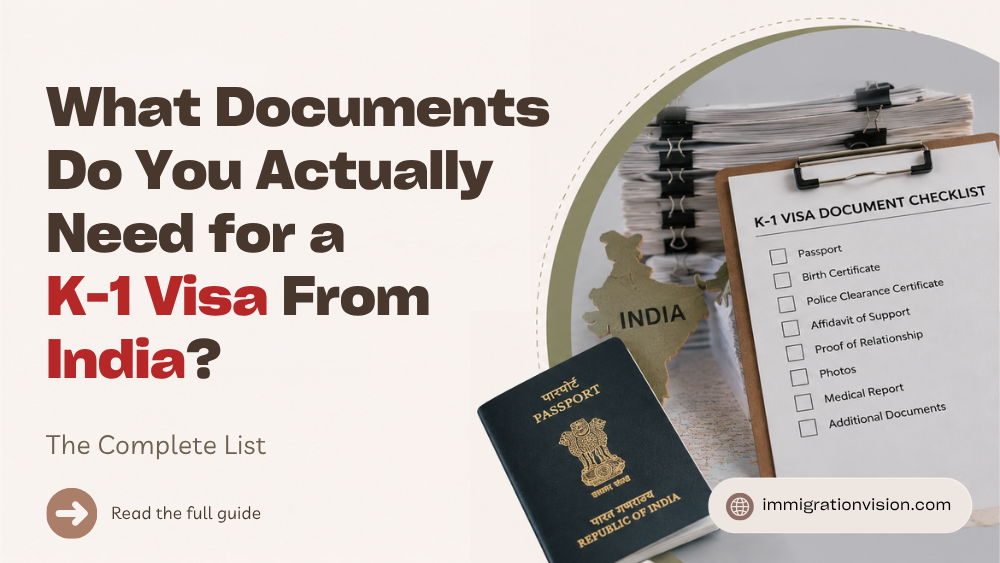
What to do: Prepare your DS-160 confirmation, valid passport, birth certificate with certified translation if needed, a recently obtained police clearance certificate, medical exam results, and Form I-134 with financial evidence.
Why it matters: This phase is where embassy officers test Indian-specific requirements, including translations, apostilles, and Mumbai-authorized panel physicians, against their expectations.
How to reduce risk: Keep the timing guidance from the section above in mind. Time-sensitive documents move faster and more smoothly through this phase.
Phase 3: Interview Day Readiness
What to do: Bring originals and photocopies of everything submitted, plus any additional relationship evidence gathered since filing.
How to make decisions with clarity: If you are unsure whether a document is enough, ask whether it adds to a consistent timeline or repeats what you have already shown. That single question keeps the file focused and effective.
What a Strong K-1 Visa Petition From India Actually Looks Like
Picture the version of this process that goes right. You file the I-129F petition with a complete, consistent evidence file, with no gaps and no contradictions. Months later, the interview request arrives at a predictable point in the timeline, as expected rather than as a surprise. The medical exam happens with an authorized panel physician on the schedule outlined earlier, vaccinations are handled in that same appointment based on CDC’s technical instructions for panel physicians, which means one visit covers everything needed for adjustment of status later. The police certificate is fresh, a certified translator has certified the translations, and every document tells the same story the petition already told.
That is a strong outcome, and it comes from preparing the documents for a K-1 visa from India in the right order, with attention to timing most couples never think to plan around.
Strong Outcome vs. Weak Outcome
| Strong Outcome | Weak Outcome | |
|---|---|---|
| Financial | One medical exam, one set of fees | Repeat exams, repeat courier and translation costs |
| Clarity and Control | Timeline is known and predictable | Extended, open-ended wait for an RFE response |
| Time | Interview and travel proceed on schedule | Delays of 60 to 90 days or more, rescheduled interviews |
| Emotional Load | Confidence replaces uncertainty | Ongoing anxiety, family pressure compounding stress |
| Long-Term | Clean record supports adjustment of status later | Petition history complicates future filings |
What This Actually Feels Like
For a couple managing careers, families on two continents, and a wedding date everyone is counting down to, the real win goes beyond visa approval. It is the quiet relief of updating your parents with good news instead of another delay. You book flights with confidence. You walk into the Mumbai interview having already answered, on paper, every question the officer is likely to ask.
Efficiency here comes from sequencing correctly the first time, so the process only has to happen once.
FAQs: K-1 Visa Documents From India
What documents do I actually need for a K-1 visa from India?
At the petition stage, you need proof of U.S. citizenship, evidence of an in-person meeting within the last two years, and documentation of an ongoing relationship. At the consular stage, you will add a valid passport, a birth certificate with certified translation if needed, a recent police clearance certificate, medical exam results, and Form I-134. Your exact list can vary based on your situation, since prior marriages and children change what the process requires.
How long does the K-1 visa process take for couples filing from India?
Timelines vary, but most couples should expect 10 to 14 months from filing the I-129F petition to visa issuance, factoring in USCIS processing, NVC transfer, and Mumbai consulate scheduling. Incomplete documentation is the most common reason this timeline extends. Couples who prepare their documents correctly the first time tend to move through each stage on schedule.
Do documents issued in India need to be translated for a K-1 visa?
Yes. Any document originally issued in a language other than English, such as birth certificates, divorce decrees, or police clearance certificates, needs a certified English translation before submission. The translator must certify that the translation is complete and accurate. Handling this step correctly the first time keeps your case on track and reduces the chance of a Request for Evidence tied to translations.
What is the difference between a K-1 visa and a CR-1 visa for Indian fiancé(e)s?
A K-1 visa fits couples who are engaged and plan to marry within 90 days of the fiancé(e)’s U.S. entry. A CR-1 visa fits couples who are already married and are pursuing a marriage-based green card directly. The right choice usually comes down to whether you plan to marry in the U.S. or have already married in India.
What should I do if my K-1 visa petition receives a Request for Evidence?
Respond to every point the RFE raises directly, using new or clarifying evidence rather than resubmitting what you already sent. Pay close attention to deadlines, since RFEs come with a fixed response window. Treat the RFE as a signal pointing to the specific part of your relationship story that needs stronger documentation, and focus your response there.
Moving Forward With Confidence
The K-1 process feels unpredictable mainly when you are gathering documents without knowing how they fit together. As this guide has shown, the documents for a K-1 visa from India work best as evidence that tells one consistent, credible story, timed correctly against Mumbai-specific requirements most generic guides skip over.
The couples who move through this process smoothly are usually the ones who understood the sequence early: what to gather first, what to time close to the interview, and what enough evidence actually looks like, worked out before filing rather than after an RFE forces a scramble.
That is the real choice in front of you right now. You can continue researching piecemeal and hope the next article fills in what the last one left out, or you can move forward with a clear, complete picture of what your case actually needs and start closing the distance between you and your fiancé(e) with confidence.
If you would like a second set of eyes on your documents before you file, or simply want to talk through where your case stands, we are glad to offer a confidential conversation focused on clarity and on protecting your timeline and your relationship going forward.