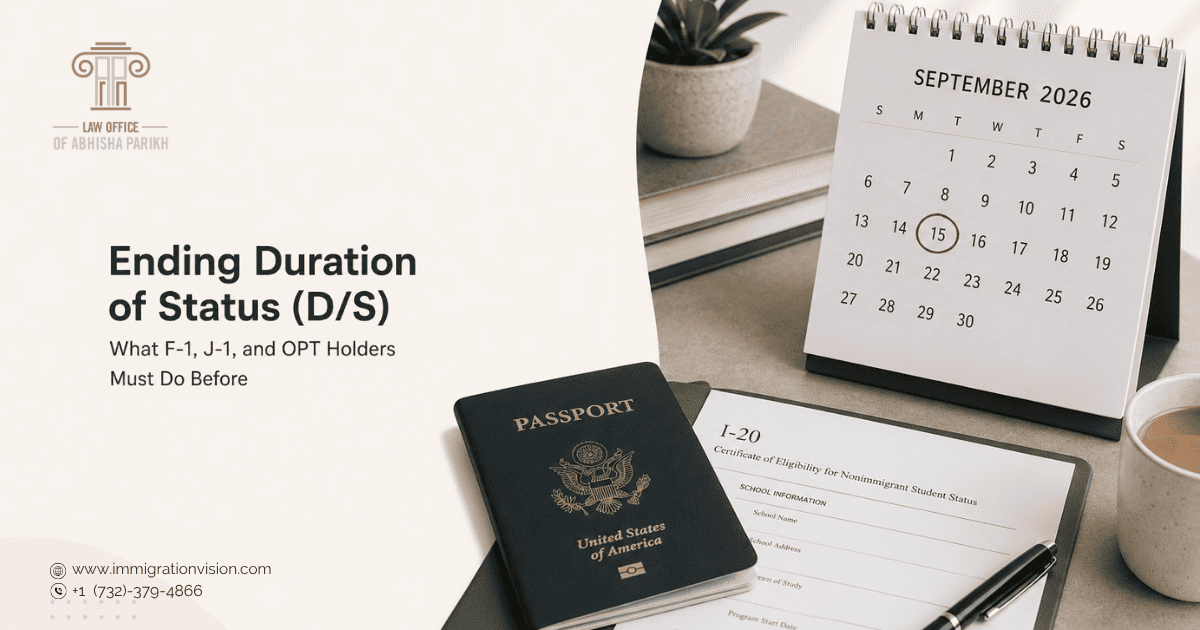
For decades, international students entering the United States on F-1 visas enjoyed a unique regulatory benefit: Duration of Status (D/S). Instead of a hard expiration date on their I-94 arrival record, students were permitted to remain in the U.S. for as long as they maintained full-time enrollment and complied with program requirements.
That era is officially over.
Following the DHS Final Rule published on July 17, 2026, the federal government is replacing D/S with a fixed Admit Until Date (AUD). If you are an F-1 student, J-1 exchange visitor, or a professional transitioning from OPT to H-1B, this structural shift drastically changes your filing deadlines, travel risks, and maintenance of status.
The 60-Second Legal Summary
- The Effective Date: On September 15, 2026, the Department of Homeland Security (DHS) officially ends “Duration of Status” (D/S) for F-1 students and J-1 exchange visitors, replacing open-ended stays with a fixed Admit Until Date (AUD) on Form I-94.
- New Fixed Limits: Foreign students will be admitted for their program length up to a maximum of 4 years. Extensions now require filing Form I-539 directly with USCIS rather than relying solely on a DSO I-20 update.
- Grace Period Cut in Half: Re-entering the U.S. on or after September 15 slashes your post-completion grace period from 60 days to 30 days.
- Strict Form Edition Cutoff: USCIS published preview editions for Form I-539 and Form I-765 marked 09/15/26. Under Policy Alert PA-2026-05, filings postmarked on or after Sept 15 using older form editions will be rejected outright with zero grace period.
D/S vs. Fixed Admission: What Is Changing?
Under the old framework, your I-94 record displayed the stamp “D/S.” Under the 2026 Final Rule, U.S. Customs and Border Protection (CBP) will stamp a specific expiration date into your passport upon entry.
- Maximum Initial Admission: Up to your Form I-20/DS-2019 end date, capped at 4 years maximum. If your academic program takes 5 years (such as a Ph.D. or dual-degree track), you must apply for an extension before your 4th year expires.
- Shift in Authority: School Designated School Officials (DSOs) can no longer grant status extensions on their own authority inside SEVIS. To extend your legal stay past your I-94 date, you must file Form I-539 (Application to Extend/Change Nonimmigrant Status) directly with USCIS and pay the required government fee.
Key Changes: Legacy D/S vs. Post-Sept 15, 2026 Rules
| Feature | Pre-Sept 15, 2026 (Legacy D/S) | Post-Sept 15, 2026 (New Rule) |
| I-94 Entry Stamp | Marked as “D/S” | Fixed “Admit Until Date” (AUD) |
| Max Initial Admission | Duration of academic program | Program end date (Capped at 4 Years) |
| Extension Authority | DSO updates SEVIS (I-20 extension) | USCIS Filing Required (Form I-539) |
| F-1 Grace Period | 60 Days post-completion | 30 Days post-completion |
| OPT/STEM Filing Window | Within 60 days of completion | Within 30 days of completion |
| Form Editions Required | Legacy versions accepted | 09/15/26 Editions ONLY (No overlap) |
Impacts on OPT, STEM Extensions, and Grace Periods
For foreign graduates, particularly Indian nationals navigating the pipeline from OPT to H-1B, the new rule introduces severe timing constraints:
A. The 30-Day Grace Period Drop
If you are inside the U.S. prior to September 15, 2026, and do not travel internationally, transitional provisions allow you to retain your 60-day grace period. However, if you travel outside the U.S. and re-enter on or after September 15, 2026, you are admitted under the new rule, reducing your post-completion grace period to 30 days.
B. Dual Filing Requirements for OPT
Under the new framework, applying for Post-Completion OPT or a STEM OPT extension requires aligning your employment authorization with your I-94 expiration. If your fixed I-94 date expires before your requested OPT period ends, you must file Form I-539 (Extension of Stay) concurrently with Form I-765 (Work Authorization).
Strict Form Edition Cutoff: Form I-539 and Form I-765
USCIS has issued an alert regarding updated form versions to reflect the fixed admission rules.
- New Form Edition Dates: 09/15/26 for both Form I-539 and Form I-765.
- Zero Grace Period: USCIS will accept older editions (Form I-539 dated 08/28/24 and Form I-765 dated 08/21/25) ONLY if postmarked or electronically submitted before September 15, 2026.
- Automatic Rejections: Any filing postmarked or submitted online on or after September 15, 2026, using an older edition will be rejected immediately.
Under Policy Alert PA-2026-05, USCIS officers are instructed to issue summary rejections for non-compliant or outdated forms without issuing a Request for Evidence (RFE) or Notice of Intent to Deny (NOID). A bounced OPT or Extension of Stay application after your I-94 expiration date can cause an immediate loss of legal status and accrual of unlawful presence.
International Travel Warnings Before vs. After September 15
If you are currently abroad or planning international travel before the fall semester, timing your return is critical:
- Returning BEFORE September 15, 2026: You will be admitted under “D/S.” As long as you remain inside the U.S. without subsequent international travel, you preserve your D/S transition protections, your 60-day grace period, and simplified OPT filing options through the transition window ending March 18, 2027.
- Returning ON OR AFTER September 15, 2026: You will be issued a fixed I-94 date. You must track this expiration date closely, adhere to the 30-day grace period, and file Form I-539 with USCIS if your program or OPT extends beyond that date.
Strategic Action Plan: How Immigration Vision Secures Your Status
Navigating federal regulatory shifts requires proactive legal guidance to prevent unexpected gaps in work authorization or status accrual. At the Law Office of Abhisha Parikh, Esq., we help students, researchers, and professional workers safeguard their immigration trajectory.
- I-94 Audit & Travel Planning: We review your travel schedule and I-94 records to ensure re-entry aligns with optimal transition rules.
- Concurrent OPT & Extension Filings: We prepare verified, error-free Form I-765 and Form I-539 packages using the mandated 09/15/26 editions to avoid summary rejections.
- Long-Term H-1B & Permanent Residency Strategy: We map out smooth transitions from F-1 OPT to employer-sponsored visas, H-1B petitions, O-1 Extraordinary Ability, or EB-2 NIW Green Cards.
Need Legal Guidance on Your F-1 Status or OPT Filing?
Do not leave your immigration status to chance during this historic regulatory shift. Contact the Law Office of Abhisha Parikh, Esq. today at (732) 379-4866 or schedule a legal consultation to review your options.
Frequently Asked Questions (FAQs)
What is changing for F-1 and J-1 visa holders on September 15, 2026?
DHS is replacing open-ended Duration of Status (D/S) with a fixed Admit Until Date (AUD) on Form I-94. Your legal stay will match your program end date, capped at a maximum of 4 years per admission.
What happens if I stay in the U.S. without traveling abroad?
If you remain in the U.S. on September 15, 2026, you retain your legacy D/S protections. You keep your 60-day grace period and can apply for OPT through March 18, 2027, without filing a separate Form I-539.
Can my DSO extend my legal status in SEVIS?
No. Updating your I-20 in SEVIS extends your academic program, but it no longer extends your legal stay in the U.S. You must file Form I-539 directly with USCIS before your I-94 expires.
How does international travel on or after September 15, 2026, affect my status?
Re-entering the U.S. instantly places you under the new fixed-date system. Your grace period drops from 60 days to 30 days, your OPT application window shrinks to 30 days post-completion, and you may need to file Form I-539 alongside Form I-765 for OPT.
Is 4 years the maximum total time I can study in the U.S.?
No. The 4-year cap applies to a single I-94 admission period. If your degree program requires more than 4 years, you must submit an Extension of Stay application on Form I-539 to USCIS before your initial 4-year period ends.
What happens if I submit an older edition of Form I-539 or Form I-765 on or after September 15?
USCIS will reject your filing outright. Under Policy Alert PA-2026-05, applications postmarked on or after September 15, 2026, that do not use the new 09/15/26 edition dates will be rejected without a Request for Evidence or Notice of Intent to Deny.
Can I change majors, transfer schools, or take a second degree under the new rule?
Undergraduates cannot transfer schools or change majors during their first academic year without SEVP approval. Graduate students cannot transfer or change programs at any point, and students completing a program after September 15, 2026, cannot enroll in a second degree at the same or a lower educational level in F-1 status.