
For years, green card applicants inside the United States treated the Adjustment of Status (AOS) process as a standard administrative checklist: meet the statutory eligibility requirements, submit Form I-485, wait for a likely interview waiver, and receive your Lawful Permanent Resident card in the mail.
In 2026, that procedural “safety net” has been dismantled.
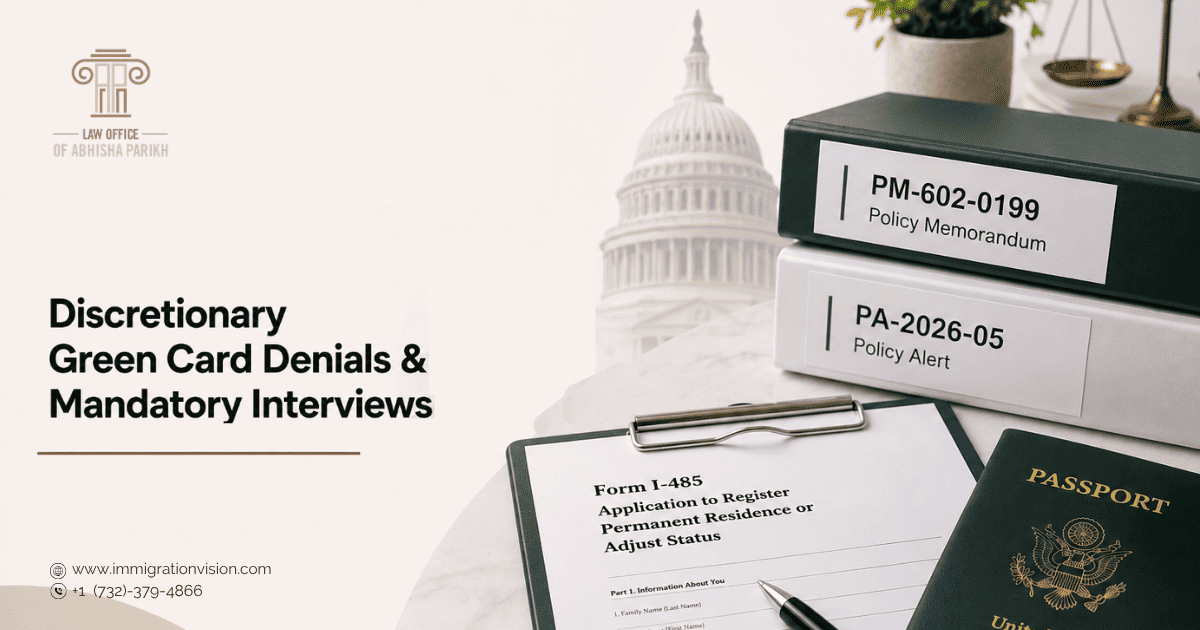
Through the combined enforcement of Policy Memo PM-602-0199 and Policy Alert PA-2026-05, the Department of Homeland Security has instructed adjudicators to exercise strict discretionary review over Form I-485 filings. Meeting basic qualification criteria is no longer a guarantee of approval. Today, an applicant must demonstrate that they deserve a green card as a matter of favorable discretion.
The 60-Second Legal Summary
- Adjustment of Status Is Discretionary: Under Policy Memo PM-602-0199, USCIS reminds officers that obtaining permanent residence inside the U.S. via Form I-485 is an “extraordinary administrative grace,” not an automatic statutory entitlement.
- End of RFE Safety Nets: Under Policy Alert PA-2026-05, USCIS officers are authorized to issue immediate denials without first issuing a Request for Evidence (RFE) or Notice of Intent to Deny (NOID) if required initial evidence is missing or if eligibility is not proven on face value.
- Mandatory Interviews Are Back: The era of widespread interview waivers for marriage and family cases is over, waiver rates have plummeted to under 10%. Furthermore, over 25% of employment-based applicants (EB-1, EB-2 NIW, EB-3) are now being called into local USCIS field offices for in-person interviews.
- Proactive Burden of Proof: Submitting the basic form checklists is no longer enough. Filers must build an affirmative discretionary record establishing that their positive equities outweigh any negative factors.
The Dual Enforcement Memos Shaping 2026 Adjudications
To understand why denial rates are rising, particularly for employment-based petitioners, applicants must understand the two major policy directives governing USCIS field offices today:
A. Policy Memorandum PM-602-0199: Adjustment as “Administrative Grace”
Issued to reinforce adjudicator authority, PM-602-0199 establishes that Adjustment of Status inside the U.S. is an exceptional alternative to standard consular processing abroad.
While the memo does not create new statutory eligibility bars, it re-emphasizes that approval rests entirely on an officer’s discretionary evaluation. An applicant can satisfy every legal requirement under the Immigration and Nationality Act (INA § 245) and still be denied if the officer finds negative factors that outweigh positive equities.
B. Policy Alert PA-2026-05: Elimination of the “RFE Safety Net”
Historically, if an applicant submitted an incomplete package, such as omitting a signed Form I-693 medical exam, tax documents for Form I-864, or complete certified translations, USCIS would routinely issue an RFE to request the missing items.
Under PA-2026-05, USCIS officers are empowered to issue summary denials without issuing an RFE or NOID if required initial evidence is missing at the time of filing. “Placeholder” filings designed to secure temporary work authorization (EAD) while assembling evidence later are now routinely rejected or denied outright.
During previous administrative years, interview waiver rates for straightforward marriage-based and family-based green cards reached record highs of over 90%. That era has officially ended.
- Family & Marriage-Based Filings: Interview waivers have fallen drastically. Field offices now default to scheduling both spouses for lengthy in-person interviews to probe relationship authenticity, financial interdependence, and personal cohabitation.
- Employment-Based Filings (EB-1, EB-2 NIW, EB-3): While a portion of employment cases are still adjudicated on paper, field offices are now scheduling in-person interviews for more than 1 in 4 employment-based applicants. Officers are scrutinizing status histories, employment fidelity, and underlying petition merit during these sessions.
Discretionary Balancing: Positive Equities vs. Adverse Factors
Under PM-602-0199, officers utilize a balancing test when reviewing Form I-485 applications. Building a strong affirmative record means highlighting positive factors while proactively addressing potential red flags.
| Factor Category | Favorable Equities (Must Emphasize) | Adverse Factors (Requires Legal Defense) |
| Status History | Continuous lawful nonimmigrant status (e.g., H-1B, L-1, F-1) | Unlawful presence, unauthorized employment, or status gaps |
| Community & Financial Ties | Homeownership, stable U.S. employment, long-term residence | Reliance on public benefits or marginal financial sponsorship |
| Family & Character | U.S. citizen or LPR immediate family ties, community service | Prior arrests, misrepresentations, or unresolved traffic/criminal records |
| Tax Compliance | Consistent, timely filing of U.S. federal and state tax returns | Unfiled taxes, tax debt, or inconsistent income reporting |
Why EB-1 and EB-2 NIW Applicants Face Heightened Scrutiny
The impact of PM-602-0199 is particularly noticeable among high-skilled applicants seeking permanent residency through EB-1A (Extraordinary Ability) or EB-2 NIW (National Interest Waiver).
Even after securing an approved Form I-140 petition, the I-485 adjustment phase is no longer a rubber stamp. USCIS adjudicators are applying a “two-step” analysis:
- Statutory Step: Is the Form I-140 approved, and is a visa current under the Visa Bulletin?
- Discretionary Step: Does the applicant’s overall conduct, status record, and prospective contribution to the U.S. warrant the exercise of positive administrative discretion?
An undisclosed status gap during student years, minor unauthorized consulting work, or inconsistent statements across historical visa applications can trigger an immediate discretionary denial at Step 2.
Strategic Defense: How Immigration Vision Audits and Secures Your Case
At the Law Office of Abhisha Parikh, Esq., we approach every Form I-485 submission with trial-ready preparation, ensuring your application withstands strict discretionary review.
- Front-Loaded Evidentiary Audits: We review your package to ensure 100% of required initial evidence, including medicals, tax returns, and certified civil documents, is present at submission, protecting your case from summary denials under PA-2026-05.
- Affirmative Discretionary Briefs: For complex status histories or self-petitioned cases, we draft a supporting legal memorandum outlining your positive equities and community contributions.
- Comprehensive Interview Preparation: We conduct mock interview sessions for both family and employment applicants, preparing you for deep-dive officer questioning at local field offices.
Facing an Upcoming USCIS Interview or Preparing Your Green Card Application?
Do not leave your green card to administrative discretion. Contact the Law Office of Abhisha Parikh, Esq. today at (732) 379-4866 or schedule a legal consultation to ensure your application is built to withstand 2026 adjudication standards.
Frequently Asked Questions (FAQs)
Can USCIS deny my green card application without sending an RFE first?
Yes. Under Policy Alert PA-2026-05, USCIS officers have full discretion to deny Form I-485 without issuing a Request for Evidence (RFE) or Notice of Intent to Deny (NOID) if required initial evidence is missing at the time of filing.
What is the purpose of USCIS Policy Memo PM-602-0199?
PM-602-0199 reminds USCIS officers that Adjustment of Status is a discretionary benefit rather than an automatic right. It directs officers to weigh positive equities against negative factors before approving an I-485 application.
Who must attend an in-person green card interview in 2026?
In-person interviews are now required for nearly all marriage-based and family-based green card applicants. Additionally, over 25% of employment-based applicants (EB-1, EB-2 NIW, EB-3) are being scheduled for field office interviews.
Does an approved I-140 guarantee my green card will be approved?
No. An approved Form I-140 confirms your statutory eligibility in an employment category, but your Form I-485 Adjustment of Status application remains subject to discretionary review and background admissibility checks.
What positive factors help outweigh minor negative issues in an I-485 application?
Positive equities include continuous lawful status, strong U.S. family ties, long-term tax compliance, steady employment, property ownership, and active community involvement.
What should I do if my Form I-485 is denied without an RFE?
If your application is denied, you must act quickly. Depending on the reasons for denial, an experienced immigration attorney can evaluate options such as filing a Motion to Reopen/Reconsider (Form I-290B), refiling a corrected application, or seeking relief in immigration court.