“I’ll cancel your papers.”
“You’ll go back to India alone.”
“You’ll lose the children.”
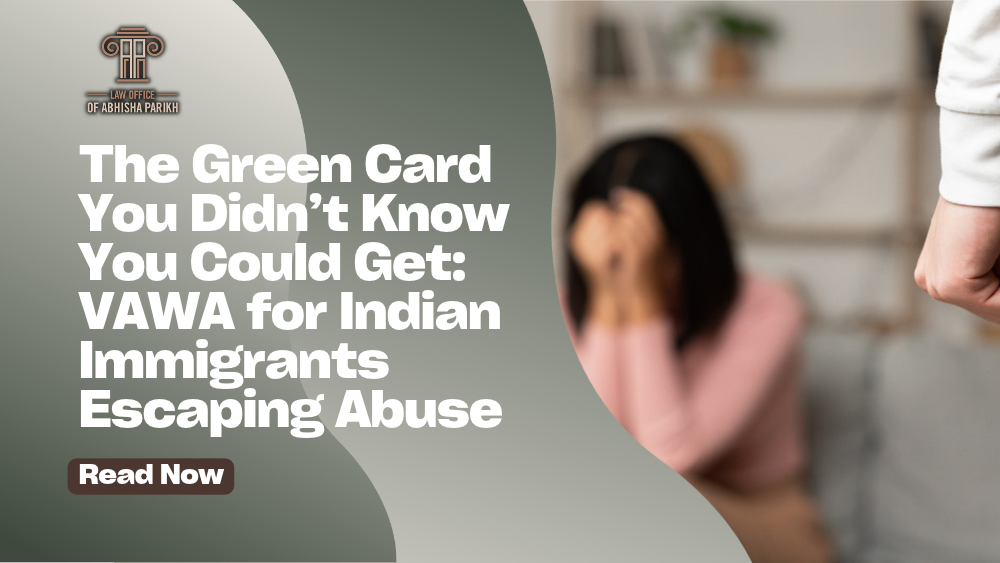
For many Indian women living in the U.S., these words carry real weight. When your visa or green card depends on your husband, his threats can feel like the final word on your future. Add the pressure of family honor, community expectations, and the fear of returning home separated, and silence starts to feel like the safest choice.
Here is a fact many survivors learn late: a VAWA green card allows an abused spouse of a U.S. citizen or green card holder to apply for permanent residence on her own. You become your own petitioner, and your case moves forward privately, independent of his signature or cooperation.
The Violence Against Women Act reaches far more situations than most families realize. Timing matters too, because every month of waiting gives the person controlling your status more time to act first.
This guide explains who qualifies, the protections built into the law, the path that fits your husband’s immigration status, and a clear roadmap you can follow safely and privately.
Your safety comes first. When possible, read this on a device only you use. Confidential support is available 24/7 through the National Domestic Violence Hotline at 1.800.799.7233.
What a VAWA Green Card Really Is, and Why Your Status Can Stand on Its Own
The Real Problem Is Control Over Your Status
Most women in this situation describe the problem as a difficult marriage. The deeper issue is leverage. When one spouse holds the immigration paperwork, that paperwork becomes a tool for control.
That leverage rests on one belief: only the sponsoring spouse can keep you in the U.S. The law offers a different answer. A VAWA self petition (Form I-360) lets you step into the role he once held and file as your own sponsor.
Once you understand this, his most powerful threat loses its force.
The Five Requirements for a VAWA Green Card
U.S. Citizenship and Immigration Services (USCIS) looks at five questions:
- Were you married to a U.S. citizen or green card holder? A recent former marriage can also qualify.
- Was the marriage entered in good faith, with the intention of building a real life together?
- Did you live with your spouse at some point?
- During the marriage, did your spouse subject you to physical abuse or extreme cruelty?
- Do you have good moral character?
Expert Insight: Arranged Marriages Meet the Good Faith Standard
Many Indian women worry that a marriage arranged or introduced through family will look suspicious to immigration officers. Good faith asks one simple question: did you marry intending to share a life? The focus is on your intention, and the way you were introduced is secondary. Arranged marriages meet this standard fully when the commitment was genuine, and wedding ceremonies, family photos, and shared plans all help show it.
Abuse Includes Far More Than Physical Harm
Many survivors hesitate because their experience feels too ordinary to count. Immigration law recognizes that control itself is a form of abuse. Extreme cruelty can include:
- Taking or hiding your passport and documents
- Controlling all money and bank access
- Cutting you off from family in India
- Repeated threats of deportation or of losing your children
- Dowry demands and ongoing harassment
- Monitoring your phone, messages, and movements
A consistent pattern of these behaviors can support a green card for an abused spouse. The key question is whether he used power to harm and control you. If the answer is yes, the law was written with you in mind.
Two Hidden Factors That Shape Every VAWA Self Petition
Hidden Factor 1: The Process Is Built Around Your Privacy
Most survivors assume that filing will alert their husband. The system is designed to work the opposite way:
- Federal law, 8 U.S.C. § 1367, prohibits immigration officials from sharing information about your VAWA case with your abuser.
- The same law bars officials from basing a decision against you solely on information he provides.
- You can list a safe mailing address, so every notice reaches you privately.
This shifts the balance of power in your favor. A threat like “I’ll tell immigration you lied” carries far less weight once you know the government is required to keep your case away from him.
Hidden Factor 2: His Visa Type Determines Your Path
This is the most overlooked factor for Indian families, because so many households arrive through H-1B and H-4 visas. A VAWA green card is available to spouses of U.S. citizens and green card holders. Every other situation follows a different route.
Use this simple map:
- Your husband is a U.S. citizen: You can usually file your petition and your green card application together.
- Your husband is a green card holder: You file the petition first, and your green card timing follows the government’s monthly Visa Bulletin.
- Your husband is on an H-1B and you hold H-4 status: VAWA falls outside your situation. Instead, abused H-4 spouses can request a battered spouse work permit (Form I-765V), and a U visa may apply when you help law enforcement with a qualifying crime.
- You hold a conditional green card valid for two years: An abuse waiver on Form I-751 lets you finalize your green card on your own.
Identifying his status first points you to the correct form, the correct timeline, and the protections that apply to you. That single step turns a confusing system into a clear path.
What Happens If You Wait: The Real Cost of Delaying a VAWA Green Card
Here is how hesitation affects each part of your life.
Legal Consequences
- A divorce starts the clock. Once two years pass after a divorce, your right to file as a former spouse may expire.
- Your husband can withdraw the petition he filed for you. Time out of status can then begin counting against you, which complicates future applications and travel.
- Deportation proceedings can begin before you file. In that case, your case moves to immigration court, where options still exist and the process becomes longer, more formal, and more stressful.
- Children approaching 21 face age rules. Filing early gives your child the strongest protection.
Financial Consequences
Many women in this situation hold degrees and professional experience from India, yet they rely on a husband for every rupee and dollar. Each month without status extends that dependence. Rent, groceries, insurance, and phone bills all stay in his hands.
An approved petition changes that equation. It opens the door to a work permit and, in many cases, certain public benefits that help you stabilize while your case continues.
Emotional and Reputation Consequences
Delay often feels safer because it keeps family and community questions at bay. In reality, waiting usually deepens isolation. The abuser shapes the story told to relatives in India, while you carry the weight in silence. Children absorb that tension daily, even when adults try to shield them.
Acting privately and early lets you decide how and when your story is shared.
Long Term, “Future You” Consequences
- Evidence fades. Messages get deleted, phones get taken, and witnesses move away.
- Your citizenship clock waits. The countdown toward U.S. citizenship begins once your green card arrives, so a later filing means a later path to full security.
The law gives you real tools, and timing determines how much those tools can do for you.
Six Steps to a VAWA Green Card, With Your Safety First
This roadmap follows the order that protects you best: safety first, clarity second, filing third.
1: Secure Your Safety and Privacy
- Do: Use a phone or computer only you access, browse privately, and choose a safe mailing address with a trusted friend, relative, or advocate.
- Why: Many abusers monitor phones, email, and mail.
- Reduce risk: Change passwords on any shared email or cloud accounts, and save the hotline number from the top of this guide under a neutral contact name.
2: Confirm Your Husband’s Immigration Status
- Do: Quietly photograph his green card, naturalization certificate, passport, or any petition he filed for you.
- Why: His status tells you which path in the map above applies.
- Reduce risk: Store photos outside your phone’s main gallery.
3: Gather Evidence Using This Checklist
- Genuine marriage: wedding photos, ceremony records, joint accounts, shared plans
- Living together: lease, utility bills, mail, children’s school records
- Abuse: saved messages, photos, medical or counseling records, statements from friends or relatives, police or protective order records if available
- Good character: a local police clearance letter
- Why: Immigration officers accept any credible evidence, so a police report is helpful and optional.
- Reduce risk: Keep copies with a trusted person or in a secure account.
4: Write Your Personal Declaration
- Do: Describe your marriage and the abuse in your own words, in order, with dates and specific examples.
- Why: Your declaration is often the strongest piece of your case.
5: File Form I-360
Submit your petition through USCIS. If your husband is a U.S. citizen, you can usually file your green card application at the same time.
6: Track Each Milestone
Expect a receipt notice, then possibly an early eligibility notice, then approval, a work permit, and finally your VAWA green card. Keep copies of every notice in your secure location.
Rule of Thumb for Clear Decisions
When a choice feels uncertain, ask one question: “Which option keeps me safest while preserving my legal options?” That answer usually points to the right next step.
What a Strong VAWA Green Card Outcome Looks Like
The Future State: A Life Built on Your Own Terms
A strong outcome looks quiet and practical. You hold a VAWA green card in your own name, and your immigration status belongs to you alone.
In practical terms, that means:
- Financial footing: A work permit, a job that uses your education and skills, a bank account in your name, and a credit history you control.
- Privacy: Your case moved forward confidentially, on your timeline.
- Family security: Your children share in your protection, and decisions about their future come from a place of stability.
- A clear path forward: Battered spouses of U.S. citizens can often apply for citizenship after three years as a green card holder, instead of the usual five.
- Support around you: Ongoing safety planning and emotional support through resources like the National Domestic Violence Hotline, which helps survivors rebuild long after the immediate crisis.
Strong Outcome vs. Weak Outcome
| Area | Strong outcome | Weak outcome |
|---|---|---|
| Financial stability | Your own income and accounts | Full dependence on the abuser |
| Clarity and control | Correct path chosen from the start | Months spent on the wrong form |
| Time | Filed within every legal window | Deadlines missed |
| Emotional load | Decisions made from security | Daily fear of threats and exposure |
| Long term protection | Permanent residence and a path to citizenship | Status that stays uncertain year after year |
How Preparation Creates Better Results
Strong outcomes follow a predictable pattern. Early action keeps your legal windows open. Organized preparation produces a clear declaration and supporting proof, which reduces requests for more evidence. The right strategy matches your path to your husband’s status, so every month of effort moves you forward.
What Peace of Mind Really Means Here
For many women, success feels simple: sleeping through the night, answering the phone calmly, and speaking with family in India on your own terms. A self petition green card gives you the legal foundation for that life. The paperwork is the tool. Independence is the result.
VAWA Green Card FAQs for Indian Immigrants
Do I have to divorce my husband to apply for a VAWA green card?
Divorce is optional. You can file while still married, whether you live with him today or have already moved out. If you are already divorced, you generally have two years from the divorce date to file, as long as the divorce connects to the abuse. Each choice about your marriage remains yours to make on your own timeline.
Can my children get green cards through my VAWA petition?
In most cases, yes. Unmarried children under 21 can usually be included in your petition, including children from a previous relationship. Your children move through the process alongside you, so one filing can protect the whole family.
When can I work while my VAWA case is pending?
Timing depends on your husband’s status. If he is a U.S. citizen and you file your green card application together with your petition, you can request a work permit at the same time. In other cases, work authorization usually follows approval of your petition. Planning for this timeline helps you prepare financially for the months ahead.
Can I get a VAWA green card if I overstayed my visa?
Often, yes. VAWA includes special protections that allow many applicants to apply for a green card from inside the U.S. despite an overstay. Certain past issues, such as prior deportation orders or criminal history, call for careful review. A full look at your entry and immigration history helps identify any concerns early.
How much does it cost to apply for a VAWA green card?
USCIS charges zero filing fee for the VAWA petition itself, and related applications are often exempt from fees or eligible for waivers under current rules. The most costly mistakes usually come from filing the wrong form or paying unlicensed “visa agents” or consultants. Confirm current fees directly with USCIS before filing.
Can men apply for a VAWA green card?
Yes. Despite its name, the Violence Against Women Act protects survivors of every gender. Husbands abused by a U.S. citizen or green card holder wife follow the same requirements and receive the same confidentiality protections.
Does abuse by my husband’s family count for a VAWA green card?
VAWA focuses on abuse by your U.S. citizen or green card holder spouse. Mistreatment by his parents or relatives can strengthen your case when your husband directs it, encourages it, or takes part in it. Harassment and control within a joint family household often fit this pattern. When the harm comes entirely from relatives, other protections may apply, so a careful review of the full picture is worthwhile.
Can I apply for a VAWA green card if I am now living in India?
In some cases, yes. A spouse living outside the U.S. may still apply when the abuse took place in the U.S. or when the abuser works for the U.S. government or military. This matters for women whose husbands left them in India or canceled their visas. Evidence from the time you lived together in the U.S. is especially important in these cases.
Your First Safe Step Toward a VAWA Green Card
For many Indian women, the hardest part of abuse is the belief that your future in the U.S. belongs to the person causing the harm. The law offers you another path.
- Core problem is control. When one spouse holds the immigration paperwork, that paperwork becomes leverage.
- Hidden dynamics work in your favor. Your case stays confidential from your abuser, emotional and financial abuse count, and your husband’s visa type points you to the right path.
- Stakes grow with time. Divorce windows close, children approach 21, and evidence fades.
Staying in uncertainty keeps your income, your safety, and your children’s stability in his hands. Moving forward with a clear strategy places them back in yours. A VAWA green card offers permanent residence in your own name, a work permit, privacy, and a path to citizenship, and early action gives that path its greatest strength.
If you are ready to understand your options, Immigration Vision offers confidential conversations about VAWA and related protections for abused spouses. You choose the phone number, email, and time that feel safe for you, and every decision afterward remains yours. One private conversation can bring clarity to your timeline, protect your rights, and help you take your next step with confidence.