A second marriage often begins with real hope. You chose again, carefully, and believed this time would be different.
When that marriage turns abusive, the fear multiplies. Your immigration status may depend on the very person causing the harm. And the questions keeping you awake often reach back to your first marriage.
Does my earlier divorce count? Does it matter that he was married before? If I leave him, is my chance gone? Could I ever marry again?
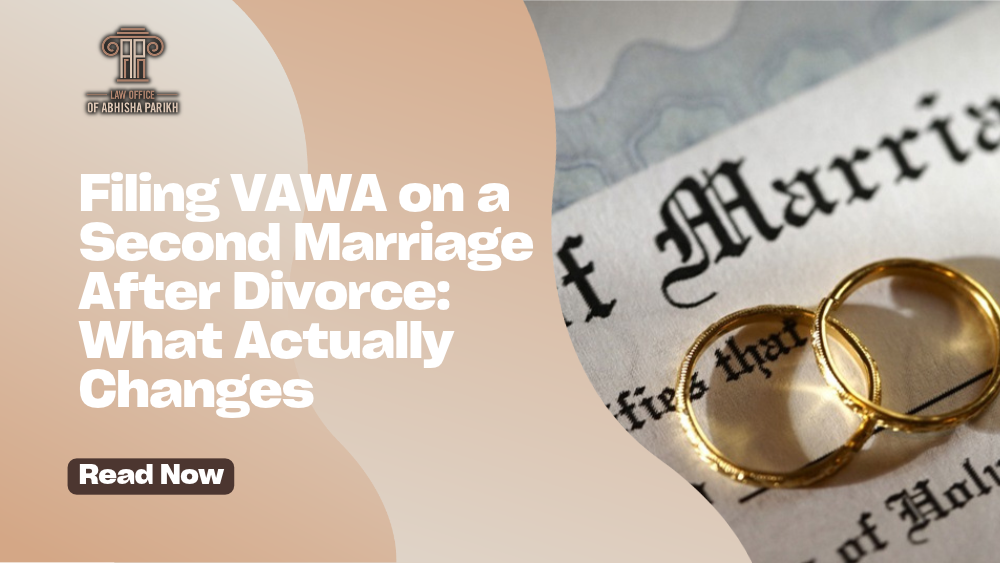
Here is the clear answer. Filing VAWA on a second marriage follows the same eligibility rules as a first marriage. The law focuses on your relationship with the abusive spouse, whatever your marital history. What changes is the proof and the timing.
Most general guides skip past these timing rules, yet they decide many outcomes. Understanding them now gives you control over decisions that are hard to reverse later.
This guide explains what changes, what stays the same, and how to protect your case from the very first step. It closes with practical answers to common questions.
VAWA filings carry strong federal privacy protections. Reading on a private device adds one more layer of safety.
Why Filing VAWA on a Second Marriage Feels Harder Than It Really Is
Most women in this situation start with the same worry: a second marriage might make them look less believable. That worry points in the wrong direction. The real issue sits one layer deeper.
A Second Marriage Qualifies on Equal Footing
VAWA asks about one relationship: your marriage to the abusive U.S. citizen or green card holder. Your earlier marital history sits outside that eligibility test.
The core requirements stay the same for everyone who files:
- A valid marriage to the abuser
- A marriage entered in good faith
- Battery or extreme cruelty during the marriage
- Time living together
- Good moral character
The Real Question: Did Every Prior Marriage Legally End First?
A marriage counts for immigration purposes when both spouses were legally free to marry on the wedding day. That rule creates two checkpoints:
- Your first divorce must have been final before your second wedding.
- Your husband’s prior marriage, if he had one, must also have ended first.
Most women focus on the first checkpoint and overlook the second. Yet an abuser who controls the paperwork may also control what you know about his own past.
The Expert Insight: “Final” Has a Specific Date
People often treat a divorce as finished once they sign the papers or attend a hearing. The law looks at a different moment: the date the court made the divorce final.
Those dates can sit months apart. A mutual consent divorce in India, for example, includes a waiting period before the final decree. A second wedding inside that gap creates a serious problem.
Two Common Beliefs, Corrected
Belief: USCIS views a second marriage with suspicion.
Reality: USCIS reviews evidence of your shared life, the same as for any marriage.
Belief: He holds the documents, so you are stuck.
Reality: VAWA accepts any credible evidence, and you can request certified copies of most records yourself.
The Overlooked Factor in VAWA After Divorce: Two Clocks Running at Once
Most guides treat VAWA timing as a single deadline. A second marriage case actually involves two separate clocks, and each one controls a different decision in your life.
Clock One: The Two Year Window After Divorce
This clock starts the day your divorce from the abuser becomes final.
- While you remain married, you can file at any time.
- After the divorce, you have two years to file.
- Within those two years, you must show a link between the divorce and the abuse.
- Once you file, a later divorce leaves your pending case intact.
That fourth point reveals something important: the order of events shapes your case. When safety allows, filing before the divorce becomes final removes the two year question entirely. The USCIS Policy Manual guidance on VAWA self petitioners sets out both the two year rule and the protection for petitions already filed.
Clock Two: The Remarriage Rule
This clock runs between filing and approval. Remarrying before approval leads to denial. Remarrying after approval leaves the approval in place.
The wait between filing and approval can stretch well past a year. For a woman rebuilding her life, a new relationship during that stretch is natural and healthy. The wedding date becomes the risk point, so the safe sequence is simple: approval first, wedding second.
When His Past Marriage Is the Weak Link
If the abuser was still legally married to someone else when you wed, a protection called the “intended spouse” rule may apply. It covers women who married in good faith, with an actual ceremony, believing the marriage was valid. His prior marriage then stays separate from your eligibility.
This protection covers his history only. Your own first divorce still needs a final date that comes before your second wedding.
What’s at Stake When a VAWA Second Marriage Case Goes Wrong
Four Fact Patterns That Change the Outcome
If your second wedding took place before your first divorce became final: The second marriage may be legally void, and the case loses its foundation.
If you remarry while your petition is pending: The VAWA path tied to your abusive spouse closes, along with the months already spent waiting.
If you file more than two years after divorcing the abuser: The deadline controls the outcome, regardless of how strong your evidence of abuse is.
If your evidence focuses mainly on the wedding day: USCIS often requests more proof of the shared life, which can add months to the timeline.
The Stakes, Category by Category
Financial. Many women in this situation depend on a spouse for status, income, or both. Until approval opens the door to work authorization, rent, groceries, and children’s expenses may still run through the abuser. Each delay extends that dependence and adds legal costs.
Legal. A denial can leave you outside valid immigration status, which creates exposure to removal proceedings.
Emotional. Every delay means more months of uncertainty, and every request for documents can reopen painful history. For mothers, the worry extends to children who need a stable home.
Reputational. In tight communities, a drawn out legal process can invite questions from relatives here and in India. A carefully prepared petition keeps the process shorter and more private.
Future you. A lost case can close your most direct route to a green card, and rebuilding that path can take years.
The Pattern Behind Every Consequence
Each outcome traces back to timing or paperwork, rather than to the strength of the abuse claim itself. These risks are predictable, and predictable risks can be prevented with preparation.
A Six Step Framework for Filing VAWA on a Second Marriage After Divorce
Each step answers one question, in order. Complete them in sequence, and every later decision rests on solid ground.
Step 1: Map Your Marriage Timeline
List every prior marriage for you and the abuser, each divorce’s final date, and your wedding date. This one page shows whether both of you were free to marry. Flag any unknown dates on his side.
Step 2: Confirm Every Divorce Is Final
Obtain certified divorce decrees showing the final date, plus certified English translations. The federal VAWA evidence rules in 8 CFR 204.2(c) require proof that each prior marriage legally ended. Confirm the decree date itself, rather than a signing or hearing date.
Step 3: Identify Your Clock
Place yourself in one category: still married, divorced within two years, or already approved. If you are divorced, mark the two year date on a private calendar.
Step 4: Time Any New Wedding Around Approval
Treat the approval notice as the green light for a new marriage. Share this rule with a new partner early, so your plans move together.
Step 5: Build Evidence for This Marriage
- Good faith: lease, joint accounts, insurance, photos across time, letters from people who knew you as a couple
- Abuse: your own detailed statement, protective orders, police or medical records, counselor letters, messages
Step 6: Protect Your Privacy
Use a safe mailing address on Form I-360. Federal law limits what USCIS can disclose and blocks reliance on information supplied solely by the abuser. A private email account and device add another layer of protection.
What a Strong Outcome Looks Like When Filing VAWA on a Second Marriage
A strong outcome goes beyond an approval notice. It means a life organized around your own choices, on a timeline you understand.
The Future State
Picture your case moving forward on one complete filing, with a documented timeline and evidence that reflects the life you actually shared. Approval then brings concrete changes:
- Deferred action, which postpones removal efforts while your case continues
- Eligibility for work authorization, so income flows into an account in your name
- Your unmarried children under 21 included in the case
- A path to permanent residence that runs through you, independent of the abuser
- Freedom to marry again, confirmed by federal law on approved VAWA petitions
Strong Outcome vs. Weak Outcome
| Area | Strong outcome | Weak outcome |
|---|---|---|
| Financial stability | Work permit, own paycheck, own lease | Continued reliance on the abuser for housing and income |
| Clarity and control | You know your clock and your next step | Decisions made under deadline pressure |
| Time | One filing, steady progress | Requests for evidence and months of delay |
| Emotional load | Painful history documented once | Repeated requests that reopen the past |
| Long term protection | Approval secured before any new wedding | A remarriage or late filing that ends the case |
What Peace of Mind Actually Feels Like
For most women in this situation, success feels quiet. Mail arrives at a safe address. A paycheck lands in your own account. Your children’s school forms list a stable home. Relatives hear about your new chapter on your terms.
The gap between these two outcomes comes down to sequence and preparation, far more than to the abuse evidence itself.
FAQs About Filing VAWA on a Second Marriage
Does USCIS recognize a divorce granted in India for a VAWA case?
Generally, yes. USCIS recognizes a foreign divorce that was valid under the law of the country where it was granted. A formal decree from an Indian family or district court provides the strongest proof. Informal or community separations may need closer review, so raise them early with your attorney.
What should I do if my first divorce decree is missing before filing VAWA?
Start by requesting a certified copy directly from the court that granted the divorce. For divorces in India, that means the family or district court where the case was decided. A trusted relative or contact in India can often help with the request. Begin early, since court records can take weeks or months to arrive.
Do I need my abuser’s cooperation to file a VAWA self petition?
VAWA is a self petition, which means you file entirely on your own. Your signature alone moves the case forward, and the abuser’s knowledge or consent sits outside the process. USCIS communicates with you directly, at the address you choose.
Does emotional abuse count for VAWA in a second marriage?
Yes. VAWA covers battery and also extreme cruelty, which includes threats, isolation from family and friends, control over money or documents, and threats about your immigration status. Many survivors experience these forms of abuse alongside or instead of physical violence. Your own detailed statement, supported by messages and letters from people who saw the effects, can carry real weight.
Do I need to live with my abuser now to file VAWA?
VAWA requires that you lived with the abuser at some point during the relationship. Current shared housing sits outside the requirement, and many survivors file after moving out. Leases, mail, utility bills, or school records showing a shared address all help prove the period you lived together.
Can I get a work permit before my VAWA petition is approved?
In some cases, yes. When the abuser is a U.S. citizen, you may be able to file your green card application together with the VAWA petition, which opens an earlier route to work authorization. When the abuser is a green card holder, the timing depends on visa availability in your category. Mapping these options early shortens the time you spend financially tied to the abuser.
Filing VAWA on a Second Marriage After Divorce: Clarity Before Your Next Step
A second marriage qualifies for VAWA on the same terms as a first. Success rests on three things: proof that every prior marriage legally ended, a filing inside the right window, and a wedding date that comes after approval.
Uncertainty keeps you waiting while the clocks keep running. Clarity puts the decisions back in your hands: when to file, what to gather, and when to plan the next chapter of your life.
If you are in immediate danger, call 911. For confidential safety planning, the National Domestic Violence Hotline is available at 1.800.799.7233.
If you are weighing a divorce, a filing deadline, or a new relationship, a confidential conversation with our team can help you review your marriage timeline and divorce documents before any step becomes hard to undo. We will listen carefully, answer your questions plainly, and help you choose a path that protects your safety, your privacy, and your future.