An EB-2 NIW lets AI and tech experts self-petition for a green card with no employer and no PERM, if they meet the three Matter of Dhanasar prongs. Federal AI priorities, America’s AI Action Plan, and a series of 2025–2026 AI Executive Orders, plus the Critical & Emerging Technologies list, now add real weight to “national importance,” but only when tied to a specific, well-evidenced endeavor.
If you build AI systems, work in advanced computing, or push a critical technology forward, you may not need an employer to sponsor your green card. The EB-2 National Interest Waiver lets the right tech professional self-petition. The catch: the standard tightened in 2025, and “I work in AI” isn’t enough on its own. Here’s how to actually meet it.
What the EB-2 NIW Is (and Isn’t)
The NIW isn’t a separate visa, it’s a waiver inside the EB-2 green card category that removes the usual job-offer and PERM labor-certification requirements. You file it yourself on Form I-140, with no employer needed. First, you have to qualify for EB-2 at all, which means an advanced degree or exceptional ability, a PhD is not required, despite the common belief. Our NIW National Interest Waiver lawyer page covers eligibility in full.
The Matter of Dhanasar Framework, Prong by Prong
Every NIW is judged against the three-prong test from Matter of Dhanasar (AAO, 2016):
| Prong | What you must show |
| 1. National importance | Your specific proposed endeavor has substantial merit and matters beyond one employer or region |
| 2. Well positioned | Your record shows you can advance it, degrees, patents, citations, funding, adoption |
| 3. Waiver Benefits U.S. | On balance, it serves the U.S. to skip the job offer and PERM in your case |
The word that decides most tech cases is specific. USCIS weighs your proposed endeavor, not the field, so “advancing AI” falls flat where “developing X to do Y, already used by Z” holds up. For Prong 2, the agency looks for objective proof you can deliver: patents, peer-reviewed publications and citations, grants and funding, product adoption, and letters from people with direct knowledge of your work, corroborated, not just asserted.
How Critical & Emerging Technologies Strengthen Your Case
The White House Critical & Emerging Technologies (CET) list, which includes artificial intelligence, advanced computing, semiconductors, cybersecurity, advanced communications, and biotechnology, is the strongest anchor for Prong 1. USCIS treats work in these fields favorably because it maps directly to documented national priorities, and STEM work tied to critical technologies or national security draws especially favorable treatment under the Prong 3 balancing test. That same alignment helps extraordinary-ability cases too; if that fits your profile, see our critical and emerging technologies EB-1A page.
Using the AI Executive Orders & AI Action Plan as Evidence
Federal AI policy has moved quickly, and several current documents support a national-importance argument, if you cite them precisely rather than in passing:
- America’s AI Action Plan (July 2025) — the government’s blueprint for AI innovation, competitiveness, and adoption across critical sectors, including the infrastructure and energy needed to support it.
- Executive Order 14179 (January 23, 2025) — “Removing Barriers to American Leadership in Artificial Intelligence”, revoked prior oversight frameworks to clear the way for U.S. AI developers and researchers.
- Executive Order 14365 (December 11, 2025) — “Ensuring a National Policy Framework for Artificial Intelligence”, created a Department of Justice AI Litigation Task Force and tied federal funding alignment to national AI standards.
- Executive Order 14409 (June 2, 2026) — “Promoting Advanced Artificial Intelligence Innovation and Security”, established a voluntary federal review framework for advanced “frontier” AI models and coordinated federal cyber-defense work, including AI-enabled protection of critical infrastructure.
Read together, these show that AI leadership, and increasingly AI security, is a sustained national priority that has carried across time, not a passing trend.
That durability is exactly what supports Prong 1. The pattern is especially useful if your work sits in frontier AI, AI safety, or cybersecurity, which EO 14409 puts squarely in the national-interest frame. But policy context never wins a case on its own: the AI Executive Order supports an EB-2 NIW, it doesn’t approve one. The line has to run from the policy straight to your specific endeavor and the evidence behind it.
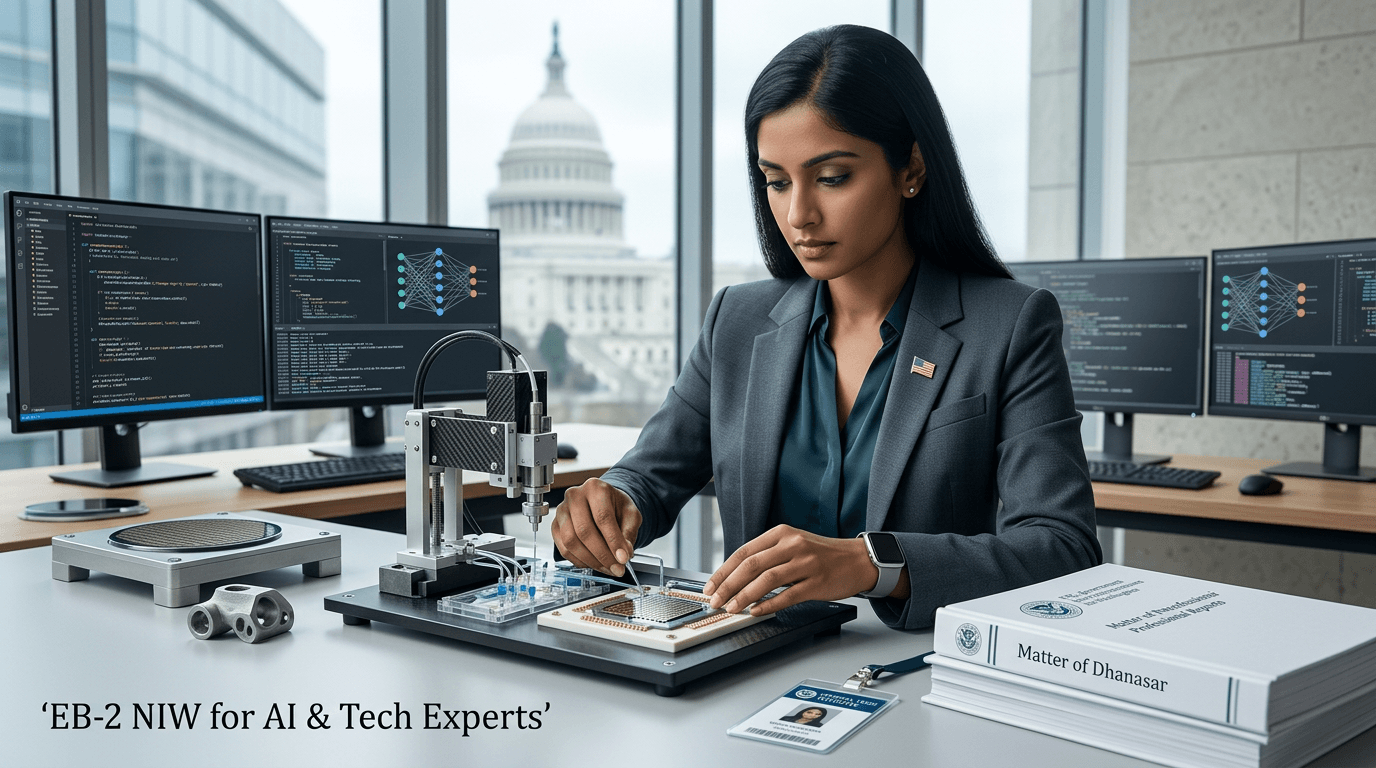
An Evidence Blueprint for AI/Tech Petitions
A strong tech NIW usually follows the same build:
- Map your endeavor to a CET category and name it precisely, the problem, the method, the users.
- Tie it to national priorities with real documentation, the AI Action Plan, the relevant Executive Order, agency reports, grants.
- Prove you can deliver: patents, citations, funding, deployment, adoption, real-world results.
- Back every claim with independent evidence, not just recommendation letters.
NIW vs. EB-1A vs. O-1: Which Fits an AI Expert?
| Route | Best for |
| EB-2 NIW | Advanced-degree tech professionals with a nationally important endeavor |
| EB-1A | Those at the very top of their field, with sustained acclaim |
| O-1 visa | Working in the U.S. now, while a green card case matures |
Many AI experts qualify for more than one. If your record is exceptional, the EB-1A extraordinary ability attorney route may be stronger; if you need to start sooner, the O-1 artist & talent visa path can bridge the gap while you build toward permanent residence.
After 2025: Stricter Scrutiny and Avoiding an RFE
In January 2025, USCIS tightened its NIW guidance (PA-2025-03), applying closer scrutiny to each prong. The proposed endeavor now has to be concrete, and expert letters must be supported by independent, objective evidence, vague predictions and unsupported endorsements carry little weight.
The most common Requests for Evidence hit exactly those two soft spots: an endeavor described as a general job rather than a specific plan, and claims propped up by letters alone. Both are avoidable with disciplined preparation and the right documentation gathered up front.
Work With an Experienced EB-2 NIW Lawyer
These cases turn on framing: connecting your technical work to a national priority and proving it against a higher 2025 bar. At the Law Office of Abhisha Parikh, we build EB-2 NIW self-petitions for tech and AI professionals, matching each endeavor to the right critical-technology and policy support, then backing it with the evidence USCIS now expects.
If you’re weighing whether your work qualifies, we’ll give you a straight answer.
Frequently Asked Questions
Does working in AI automatically qualify for an EB-2 NIW?
No. USCIS evaluates your specific proposed endeavor and evidentiary portfolio rather than the field itself. While operating within a critical technology sector helps establish national importance, the endeavor must still be thoroughly defined and documented.
Do I need a Ph.D. to apply?
No. You need to meet standard EB-2 eligibility requirements, either holding an advanced degree or demonstrating exceptional ability in your technical field.
Can I cite the AI Executive Order in my petition?
Yes, as supporting national-priority context. Recent AI Executive Orders and federal action plans help establish sustained government interest, but they must connect directly to your individual work rather than stand alone.
Can I self-petition for an NIW while working on an H-1B visa?
Yes. The EB-2 NIW is self-filed on Form I-140, meaning it does not require your employer’s sponsorship, consent, or knowledge.
Is premium processing available for tech NIW petitions?
Yes. Premium processing is available for Form I-140 NIW petitions, with a fee of $2,965 for requests postmarked on or after March 1, 2026.
How long does an EB-2 NIW process take?
Timelines vary based on USCIS workloads and whether you opt for premium processing. A professional consultation is the most effective way to map a realistic schedule tailored to your background.
Reviewed by Abhisha Parikh, Esq., an immigration attorney whose practice is devoted entirely to U.S. immigration law. This article is general information, not legal advice; eligibility depends on the facts of each case, and immigration rules change. Policy references include USCIS guidance PA-2025-03 (January 2025); America’s AI Action Plan (July 2025); and Executive Orders 14179 (January 2025), 14365 (December 2025), and 14409 (June 2026).