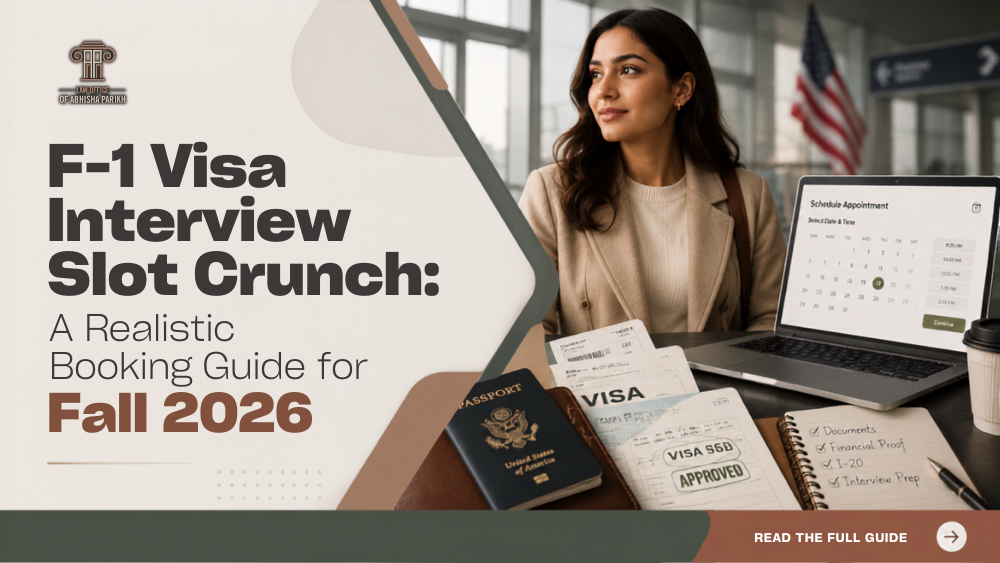
F-1 Visa Interview Slot Crunch: A Realistic Booking Guide for Fall 2026
You have the I-20. You have the admission letter. The missing piece is an interview date. Every day that passes without one feels like a countdown running on someone else’s clock.
This is the moment thousands of Indian students are living in right now, heading into Fall 2026. The F-1 visa interview slot crunch reflects a real, measurable shift in how U.S. consulates are processing student visa applications this year. It is catching even well prepared students off guard.
Here’s what many students overlook: the real constraint is not the number of appointments listed. It’s the time each interview now takes to complete. In 2025, expanded screening procedures were introduced for student visa applicants, adding real time to every case a consular officer reviews. That means the same number of appointment slots now moves fewer people through the system each day.
Refreshing the booking portal at 2 a.m. changes little on its own. The same goes for panic, or paying someone who claims they can unlock a hidden slot.
What will help is understanding exactly why this is happening. It also means knowing what actually moves your interview date sooner. From there, you can build a realistic booking timeline that protects your enrollment date instead of leaving it to chance.
That’s what this guide walks through, clearly and with practical steps you can act on today.
The Real Constraint Is Time, Not Appointment Count
Most students assume the F-1 visa interview slot shortage comes down to simple math: more applicants than available openings. That explanation feels intuitive, but it misses the actual mechanism.
The real shift happened in 2025, when the U.S. Department of State announced expanded screening procedures specifically for F, M, and J visa applicants. Under this guidance, consular officers now conduct a comprehensive and thorough vetting, including online presence, of all student and exchange visitor applicants. That review happens in addition to the standard interview.
Here’s the reasoning that matters: if every interview now takes longer to complete, the same number of daily appointment slots produces fewer finished cases per day. Student visa appointment availability often looks unchanged on paper, while the effective throughput quietly declines.
Why This Matters More for You Than for Past Applicants
If you’re comparing your booking experience to a friend’s from two or three years ago, you’re comparing two different systems. A normal wait time from a previous cycle offers limited insight into this one.
There’s a second layer students rarely hear explained clearly: the vetting process requires setting social media profiles to public before a case can move forward. This step functions as a real part of how quickly your file clears the queue, not just a formality. Reviewing this requirement well before your interview is one of the simplest ways to avoid delay.
Understanding this dynamic changes how you should plan. Treat this as a slower moving system that rewards early booking and a realistic buffer, rather than one you can outsmart with clever timing.
What’s Really at Stake If You Misjudge the F-1 Visa Interview Timeline
Financial Stakes
Picture a student with an I-20 for a September start, a five hundred dollar non refundable tuition deposit already paid, and a partial scholarship tied to enrolling for that specific term. If the F-1 visa interview slot comes through too late, that deposit is often forfeited, and scholarship terms frequently apply only to the original enrollment date.
For families who have already stretched to cover application fees, testing costs, and SEVIS fees, a missed start date becomes a significant financial setback, real money lost to a timing problem rather than an eligibility problem.
Legal and Procedural Stakes
A missed program start can trigger a chain reaction that catches many students by surprise: a new I-20 with a later start date, a fresh SEVIS record, and sometimes a new SEVIS fee payment. This reflects how the system resets when a student visa interview appointment arrives too late, not any wrongdoing on the student’s part. It does mean starting the entire booking process again, often during an even busier season.
Emotional Stakes
There’s a quieter cost here too. For a student who worked for years toward this acceptance, a deferral can feel like personal failure, even when it’s entirely a scheduling issue outside their control. Explaining a delay to family, especially when relatives back home are already asking when do you leave, adds pressure that is entirely separate from academic readiness.
Long-Term, “Future-You” Stakes
A delayed start can also ripple forward: a lost on-campus job tied to the original term, a shifted graduation timeline, or a compressed OPT window down the road. What looks like a short-term scheduling delay today can quietly reshape timelines years out.
Understanding these stakes early is what separates a stressful scramble from a manageable, well-timed plan.
A Realistic Booking Framework for F-1 Visa Interview Slots
Step 1: Build Your Timeline Backward From Your Program Start Date
Start counting backward from your program’s start date rather than forward from today. For a Fall 2026 term, that means treating your I-20 issuance date, DS-160 completion, and SEVIS fee payment as tasks with hard internal deadlines, ideally wrapped up 8 to 10 weeks before your term begins. This matters because your F-1 visa interview slot becomes available to request only after these steps are complete, so delays here directly delay everything that follows.
Step 2: Book the First Available Slot, Even If It Looks Late
This is where instinct often works against students. The logical impulse is to wait for a good date. The better move is to book the earliest available student visa interview appointment immediately, no matter how far out it looks, then keep monitoring.
Why it matters: Appointment systems release new openings regularly. Once you’re booked, you can move to an earlier slot, but only if you already hold a place in the system.
What to avoid: Leaving the DS-160 or fee payment unfinished while waiting for a better time to book. Every day spent unbooked is a day spent outside the queue entirely.
Step 3: Check Regularly for Earlier Openings
Set a recurring reminder, daily or every other day, to check for earlier dates. According to SEVP’s official guidance, students may enter the U.S. within 30 days of their program start date, so there’s a real ceiling on how early arrival makes sense. Still, holding an earlier interview date as a buffer carries real value.
Step 4: Know Your Expedite Criteria Before You Need Them
Understand in advance what qualifies for an expedited request. A documented program start date is a recognized reason. Knowing this now, rather than during a panic, reduces risk and keeps your decision making clear headed.
What a Strong F-1 Visa Interview Outcome Actually Looks Like
The Version of This Story Where Everything Goes Right
Picture this instead: it’s early July. Your I-20 has been in hand for weeks. Your DS-160 was submitted the same day it was ready, your SEVIS fee was paid immediately after, and you booked the first available F-1 visa interview slot, even though the date initially looked later than you wanted.
Since then, you’ve checked the portal every few days. Twice, earlier openings appeared, and you moved your appointment up both times. By the time your interview actually happens, you’re walking in with weeks of buffer before your program start date, rather than a handful of days.
That’s what disciplined, early action produces.
Strong Outcome vs. Weak Outcome, Side by Side
A weak outcome looks like this: booking delayed by indecision, a scramble for a student visa appointment three weeks before term starts, a stressful expedite request filed without preparation, and a family back home anxiously refreshing flight prices with no confirmed date to plan around.
A strong outcome looks like this: early booking, steady monitoring, documentation ready before it’s needed, and a clear answer any time someone asks when do you leave, because you actually know.
Why This Matters Beyond the Interview Itself
This difference extends well beyond avoiding a missed start date. It’s about arriving in the U.S. with financial deposits protected, scholarship terms intact, and energy focused on preparing for school instead of crisis management.
This kind of preparation matters at scale, too. The Institute of International Education’s Open Doors report tracks over a million international students enrolled in U.S. institutions each year, underscoring just how many students are moving through this same system simultaneously, which is exactly why early, deliberate action matters more now than in years past.
Peace of mind, in this process, is the direct result of timing done right.
F-1 Visa Interview Slot FAQs for Fall 2026
Why are F-1 visa interview slots so hard to find this year?
Expanded screening procedures added a review step to every student visa interview, so the same number of daily appointment slots now processes fewer completed cases. The shortage reflects reduced throughput more than a true drop in available appointments.
Does making my social media public actually affect my visa timeline?
Setting your profiles to public is now a required step in the review process, and skipping it can slow your case down or trigger additional scrutiny. Treating this as a standard requirement, rather than an optional formality, keeps your timeline on track.
Can I book my F-1 visa interview at a different consulate if my home city is backed up?
In limited cases, students who are legally present in another country may apply there instead. For most students applying from India, planning around your home consulate’s realistic timeline is the more reliable strategy compared to counting on third country processing.
How many days before my program start date can I enter the United States?
Students may enter the U.S. within 30 days of their program start date under SEVP guidance. This creates a natural ceiling on how early arrival makes sense, though holding an earlier interview date still gives you valuable buffer room.
Should I pay a third party service to secure a faster F-1 visa interview slot?
Services that claim to unlock hidden appointment slots carry real financial and security risk, and the underlying pace of consular processing typically stays the same regardless. Early booking through the official system, combined with steady monitoring, remains the most reliable strategy.
What’s the biggest mistake students make with F-1 visa interview timing?
The most common and costly mistake is waiting for ideal conditions before booking. Students who book the earliest available slot immediately and adjust later consistently land in a stronger position than students who delay in hopes of finding a better date.
Conclusion
The F-1 visa interview slot crunch heading into Fall 2026 has a clear, explainable cause rather than mystery or bad luck. It’s the direct result of expanded screening procedures that added real time to every student visa interview, quietly slowing a system that used to move faster. Once you understand that, panic refreshing and rumor chasing lose their grip, and a clear plan takes their place.
The students who come through this process with scholarships intact, deposits protected, and peace of mind still in one piece are the ones who booked early, understood the real timeline, and made decisions based on how the system actually works right now, not how it worked two years ago.
You have a better option than hoping for the best or carrying this stress alone. If your program start date is approaching and your interview timeline feels uncertain, a confidential conversation can help you understand exactly where you stand and what realistic options remain, before small delays turn into costly ones. Sometimes the most protective step is simply talking it through with someone who sees this pattern every day.