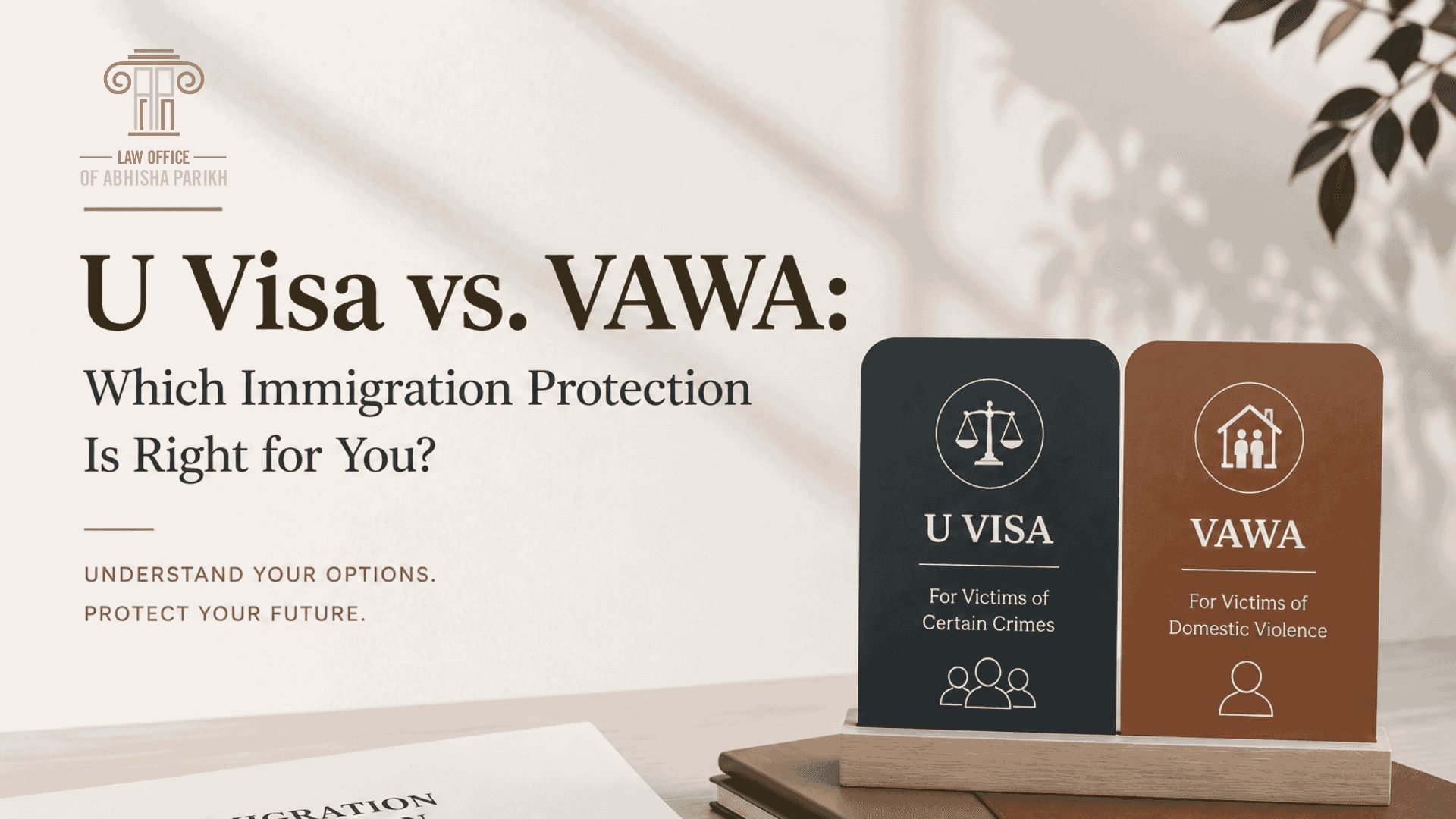
The U visa protects victims of a qualifying crime who help law enforcement; it’s capped at 10,000 a year and requires a police certification. VAWA is a confidential self-petition for someone abused by a U.S. citizen or green-card-holding spouse, parent, or adult child, no police report, no cap.
Some survivors qualify for both. Which one fits comes down to who harmed you and how you’re related to them.
| Your situation | Likely option | Why |
| You’re a victim of a qualifying crime and helped the police | U Visa | Broad crime list and generous waivers, but a 10,000/year cap and a long wait |
| You were abused by a U.S. citizen or LPR spouse, parent, or adult child | VAWA self-petition | No cap, no police report; a green card can come quickly if your abuser is a citizen |
| Harmed by a USC/LPR family member, and it was a qualifying crime | Possibly both | Each has different strengths; a lawyer helps you choose or sequence them |
| You’re not sure | Talk to a lawyer | Small eligibility details change the whole answer |
What Is a U Visa?
A U visa provides temporary legal status to victims of certain qualifying crimes committed in the United States, including domestic violence, sexual assault, human trafficking, and felonious assault. To qualify, you must show that you suffered substantial physical or mental abuse, have information about the crime, and have cooperated with law enforcement.
Your petition (Form I-918) must also include a signed Supplement B certification from a qualifying law enforcement agency. A U visa is valid for up to four years, includes work authorization, and may allow eligible family members to receive benefits. After three years in U status, you may apply for a green card. Learn more on our U Visa Lawyer page.
What Is a VAWA Self-Petition?
A VAWA self-petition allows individuals abused by a U.S. citizen or lawful permanent resident spouse, parent, or adult child to apply for a green card without the abuser’s involvement. Despite its name, VAWA protects eligible survivors of all genders.
Instead of a police certification, applicants file Form I-360 and provide evidence of battery or extreme cruelty, including emotional or psychological abuse. They must also demonstrate good moral character. There is no annual cap on VAWA petitions, and many applicants can move directly toward permanent residence. Learn more on our VAWA Immigration Lawyer page.
U Visa vs. VAWA: The Key Differences
| Factor | U Visa | VAWA |
| Who harmed you | Anyone, stranger, employer, partner | A USC/LPR spouse, parent, or adult child |
| Police certification | Required (I-918 Supplement B) | Not required |
| What you prove | A qualifying crime + cooperation | Battery or extreme cruelty (incl. emotional) |
| Annual cap | 10,000 principals/year | None |
| Interim work permit | Via Bona Fide Determination | Via prima facie / pending case |
| Green card | After 3 years in U status | Right away, if the abuser is a U.S. citizen |
| Waivers of inadmissibility | Very broad | Narrower |
| Good moral character | Not a separate requirement | Required |
In plain terms: the U visa casts a wider net on who qualifies and offers more forgiving waivers if your record is complicated, but you need law enforcement on board, and the cap means a long wait. VAWA is narrower on relationship but far more private, needs no police, and can reach a green card faster.
Which Option Fits You?
Your specific circumstances determine the best path. Consider:
- Nature of abuse: Was the harm inflicted during a crime incident that law enforcement is involved in? (If so, U visa.) Was it domestic or familial abuse by a qualifying relative? (If so, VAWA.)
- Abuser’s status: If your abuser is undocumented or unrelated, a U visa is likely your only option. If the abuser is a U.S. citizen or green card spouse/parent/child, VAWA may apply.
- Reporting concerns: Victims afraid to report to police should note that VAWA does not require any official report, whereas U visas do.
- Urgency for green card: If obtaining permanent residence as soon as possible is critical, and you qualify for VAWA, that path is generally quicker.
Example: If you helped police after a violent crime but have no family tie to the offender, we would guide you toward the U visa process. If you endured domestic violence from a U.S. citizen spouse, we would explain filing the VAWA self-petition. In either case, our priority is your safety and your rights.
How Long Does Each Take?
Neither option offers a quick resolution, so understanding the timeline is important. VAWA self-petitions currently take around 40-50 months to process, according to recent USCIS processing times. U visas generally take much longer due to the annual cap and a significant application backlog, with many applicants waiting several years for a final decision.
While you wait, you may still qualify for interim benefits. Eligible U visa applicants may receive a Bona Fide Determination. In contrast, certain VAWA applicants may receive a prima facie determination, which can provide access to work authorization and other protections before the final decision.
Recent Updates & Common Filing Mistakes
USCIS has increased its focus on supporting evidence in humanitarian petitions, making complete and well-documented applications more important than ever. Missing documentation, weak evidence, or filing under the wrong category can lead to delays or a Request for Evidence (RFE).
Some of the most common mistakes include filing VAWA when the abuser doesn’t meet the relationship requirements, submitting an incomplete law enforcement certification for a U visa, or providing insufficient evidence of abuse. If your case involves human trafficking, a T visa may be a more appropriate immigration option and should be evaluated before filing.
Why This Is Worth an Immigration Lawyer’s Help
These cases turn on evidence and strategy, medical records, affidavits, and police documentation, assembled to meet a standard that just got stricter. A good attorney also protects the confidentiality VAWA survivors are entitled to, knows which waivers apply, and heads off the RFEs that stall cases for months. At the Law Office of Abhisha Parikh, we help survivors choose the right path and build it properly.
Frequently Asked Questions (FAQs)
What types of crimes qualify someone for a U visa in the United States?
A U visa is available for victims of qualifying crimes such as domestic violence, sexual assault, human trafficking, kidnapping, robbery, and other serious offenses. You must have suffered substantial abuse and be willing to assist law enforcement during the investigation or prosecution.
Who is eligible to file a VAWA self-petition?
VAWA allows abused spouses, children, and parents of U.S. citizens or lawful permanent residents to self-petition for immigration benefits. Both men and women can qualify, and the process remains confidential without notifying the abuser.
Do I need a police report to apply for a U visa or VAWA?
A U visa requires a law enforcement certification confirming your cooperation. VAWA does not require a police report, although medical records, court documents, or other evidence can help support your case.
Can I apply for both a U visa and VAWA at the same time?
In some situations, yes. If you meet the eligibility requirements for both programs, an immigration attorney may recommend pursuing both options. Each petition is reviewed independently by USCIS.
Is a VAWA petition faster than applying for a U visa?
In many cases, yes. VAWA petitions generally move faster because they are not subject to annual visa caps. U visa applicants often face longer wait times due to high demand, although eligible applicants may receive work authorization while waiting.
Can my spouse or children receive immigration benefits with my application?
U visa applicants may be able to include certain qualifying family members as derivative beneficiaries. VAWA does not provide derivative benefits, but once permanent residence is granted, eligible family members may later be sponsored through family-based immigration.
Why should I work with a U visa lawyer or VAWA immigration lawyer?
Both immigration options involve detailed legal requirements and extensive documentation. An experienced U visa lawyer or VAWA immigration lawyer can evaluate your eligibility, prepare a complete petition, and help avoid common mistakes that may delay or affect your case.