
Getting an O-1 petition denied feels personal. You’ve spent years building a career worth recognizing, assembled what looked like a strong case, and USCIS still said no.
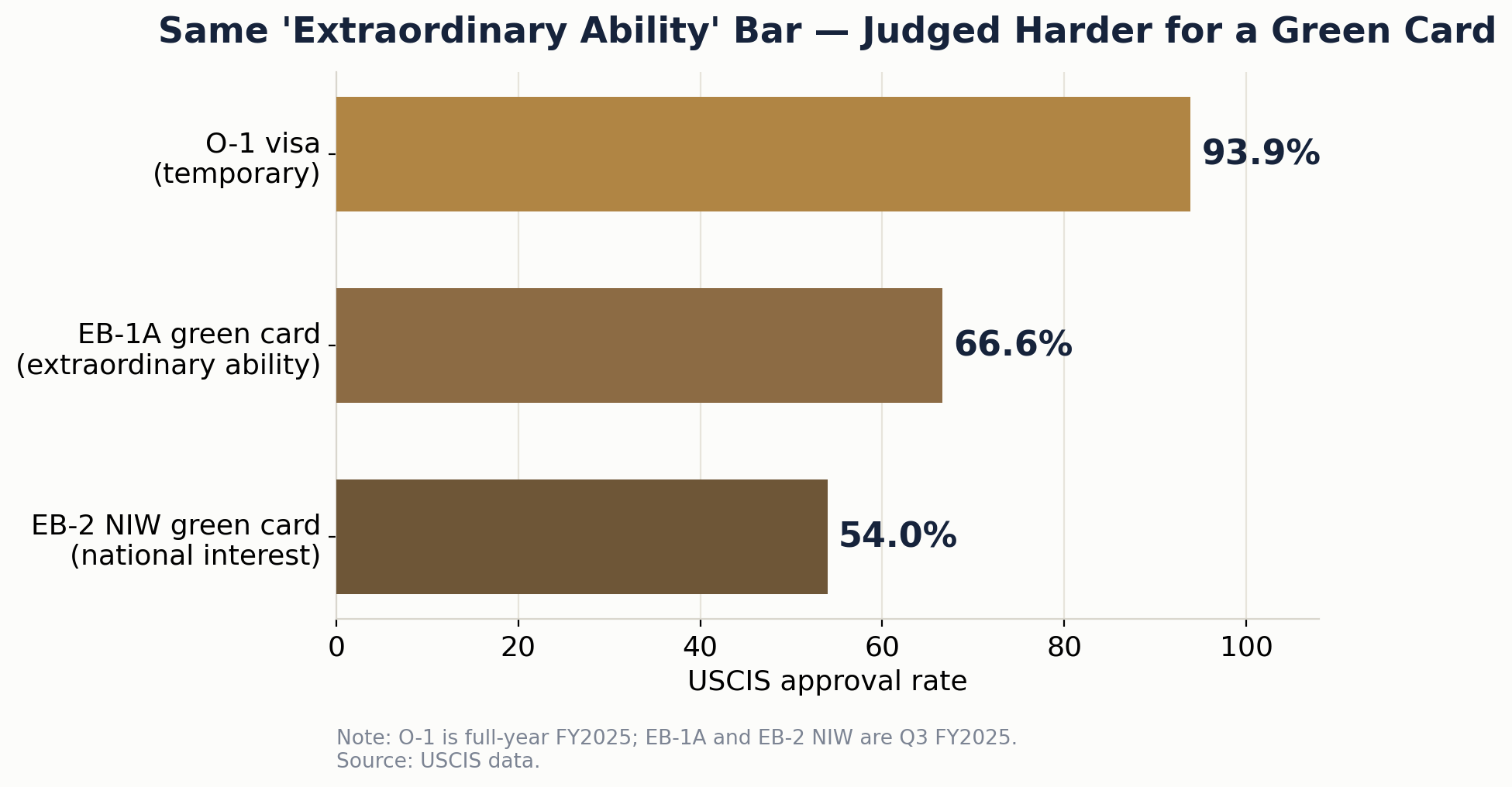
Here’s the context that matters: the O-1 isn’t a long shot. In FY2025, USCIS approved about 93.9% of O-1 petitions, 29,733 approvals to 1,948 denials, and the State Department issued a record 20,015 O-1 visas. So a denial usually isn’t a sign you don’t qualify. It’s a sign something specific in the petition fell short, and specifics can be fixed.
RFE, NOID, or Denial: Know What You’re Holding
“Denied” gets used loosely, but USCIS has three different outcomes, and your next move depends on which you received.
- Request for Evidence (RFE): not a denial. The officer needs more before deciding. Only about 19.7% of O-1 petitions got one in FY2025 (down from 28% in 2021), and roughly 71% were still approved after a solid response.
- Notice of Intent to Deny (NOID): more serious. The officer is leaning toward no and giving you a final chance to respond.
- Denial: the final decision, carrying formal appeal and motion rights.
Confirm which you’re holding first, because each has different deadlines.
The Most Common O-1 Visa Denial Reasons
When we review denied O-1 petitions, the cause almost always comes back to one of these issues. In many cases, the applicant has the qualifications, but the petition doesn’t present the evidence in a way that satisfies USCIS. Most denials are less about talent and more about how the case was prepared.
1. Failing the “Final Merits” Test
This is the biggest reason many applicants don’t expect. Meeting the evidentiary criteria, at least 3 of 8 for O-1A or 3 of 6 for O-1B in the arts, is only the first step. USCIS then looks at the entire petition and asks whether the evidence truly shows someone at the top of their field.
You can technically satisfy the required criteria and still receive a denial if the overall record appears accomplished but not extraordinary. The criteria open the door, but the overall narrative and supporting evidence determine whether the case succeeds.
2. Evidence That Only Shows Regional Recognition
The O-1 visa requires evidence of national or international acclaim. A petition built mainly on local awards, regional media coverage, or recognition within one city or organization may satisfy a criterion while still failing to demonstrate the broader recognition USCIS expects.
The strongest petitions show achievements that extend beyond a local audience and establish a reputation across the industry or on a national or international level.
3. Weak or Generic Recommendation Letters
Recommendation letters are one of the most common areas where petitions fall short. Letters that are vague, repetitive, or clearly drafted by the applicant provide little value. USCIS is looking for detailed, credible letters from respected professionals who can explain exactly what the applicant accomplished and why those achievements are significant.
A few well-written, personalized letters are almost always more persuasive than a large collection of generic endorsements.
4. Advisory Opinion (Consultation) Problems
Most O-1 petitions require a written advisory opinion from the appropriate peer group, labor organization, or management organization. Submitting the wrong consultation, an incomplete opinion, or failing to include one when required can create an avoidable reason for denial.
Although this is a procedural requirement, it plays an important role in establishing the credibility of the petition.
5. Itinerary and Agent Relationship Gaps
Applicants working through a U.S. agent or multiple engagements must provide a clear itinerary and properly document the agent relationship. Vague schedules, incomplete contracts, or open-ended work plans often raise concerns during USCIS review.
This is a common issue for freelancers, performers, artists, and other professionals who do not have a single long-term employer.
6. Published Material and Impact Challenges
Media coverage alone isn’t enough. USCIS may conclude that articles are not truly about the applicant, come from sources with limited relevance, or fail to demonstrate meaningful professional recognition.
Every piece of published material should clearly support the eligibility criterion it is intended to satisfy and reinforce the applicant’s extraordinary ability.
7. Simple Filing and Documentation Errors
Some petitions are weakened by avoidable mistakes such as inconsistent information, missing signatures, incorrect filing fees, or evidence submitted without explaining which O-1 criterion it supports.
USCIS evaluates the petition based on the evidence presented. A well-organized filing that clearly connects every document to the legal requirements is often just as important as the evidence itself.
What to Do If Your Extraordinary Ability Visa Is Denied
A denial is a setback, not the end. You generally have three paths:
- Motion to Reopen or Reconsider (Form I-290B) — back to the same office, for new evidence (reopen) or a legal error (reconsider). Usually due within 30 days.
- Appeal to the AAO — also Form I-290B; the Administrative Appeals Office reviews the decision fresh, won on legal argument.
- Refile a stronger petition — often the most practical fix when the record was thin. The O-1 has no cap and no lottery, so you can refile anytime.
The right path depends on why you were denied: a legal misreading points to a motion or appeal; weak evidence points to refiling. If you’re also weighing a permanent move, our guide on choosing between the O-1 and EB-1A is a useful next read.
How an O-1 Visa Lawyer Helps You Avoid a Denial
Nearly every denial shares one cause: the applicant was qualified, but the petition didn’t prove it. The fix is a petition built to be approved from day one, leading with your strongest criteria, tying every exhibit to the criterion it supports, securing the right advisory opinion early, and writing a narrative that survives the final-merits review.
That’s where an experienced O-1 visa lawyer matters most, especially after a first denial, when a second preventable one is far harder to recover from. At the Law Office of Abhisha Parikh, we build O-1 petitions that hold up to scrutiny and regularly step in after a denial to chart the right path forward.
Frequently asked questions
Does an RFE mean my O-1 will be denied?
No. An RFE simply means USCIS wants more before deciding. Most O-1 petitions that receive an RFE are still approved after a strong, timely response.
How long do I have to respond or appeal?
It depends on the notice. RFEs and NOIDs state their own deadlines, and a Motion or appeal on Form I-290B is generally due within 30 days of the denial. Deadlines are strict; missing one usually forecloses the option, so confirm your date immediately.
Can I just refile instead of appealing?
Often, yes, and it’s frequently the smarter move when the denial came from weak evidence rather than a legal error. The O-1 has no cap and no lottery, so you can file a stronger petition at any time.
Why was I denied if I met three criteria?
Because meeting the criteria is only half the test. USCIS also conducts a “final merits determination” weighing all your evidence together to decide whether you’re genuinely among the top of your field. Many denials happen at this second step.
Is a denial held against me in future petitions?
A prior denial isn’t an automatic bar, but USCIS can see your history, so consistency matters. A well-prepared refiling that directly resolves the earlier concerns is far stronger than one that ignores them.