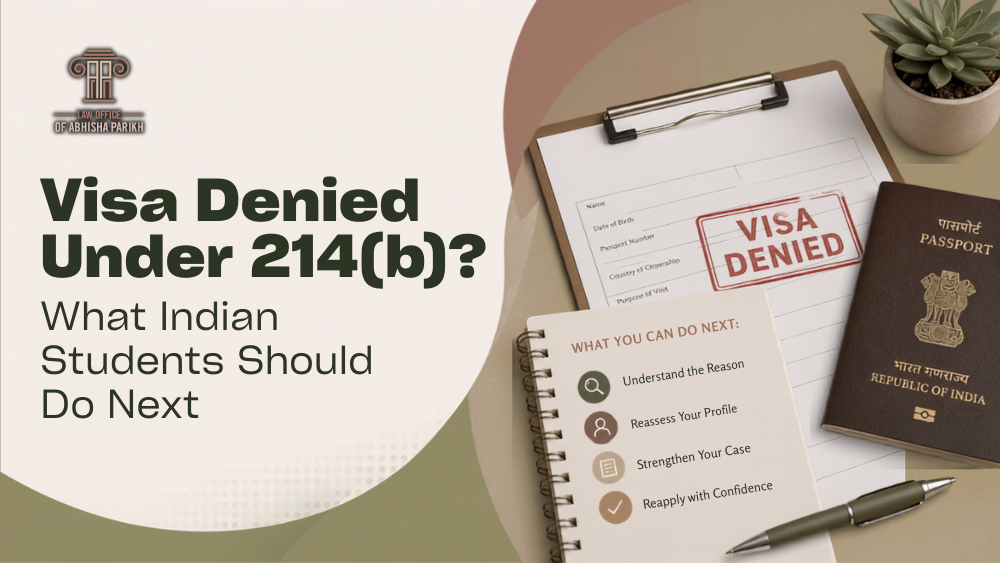
The refusal slip is smaller than you expect. Just a checkbox and a citation to Section 214(b), leaving months of preparation to end in two minutes at the consulate window.
If you’re an Indian student denied under 214(b), you already know the feeling. One moment you’re answering questions about your program and your plans. The next, you’re walking out with a blue slip and a hundred unanswered questions: Was it something I said? Can I apply again? Does this follow me forever?
Here’s what almost nobody tells you clearly: a 214(b) denial reflects a narrow legal standard, applied in a snapshot decision within minutes, a standard most applicants only come to understand after they’ve already faced it. It says far more about the interview than about your intelligence, your grades, or your worth as a candidate.
That gap in understanding is exactly what costs students their next intake. With SEVIS deadlines and program start dates fixed on the calendar, every week spent guessing brings you closer to losing a semester, or a full year.
This article breaks down what actually happened, why the standard explanations rarely tell the full story, and what a genuinely stronger reapplication looks like: a real framework, built for your specific situation.
What a 214(b) Visa Denial Really Means
Section 214(b) functions as a legal starting point, not a punishment. The law assumes every visa applicant intends to stay in the US permanently, and the burden falls on you to show otherwise. Understanding this changes everything about how you interpret what happened.
Most students misdiagnose their F1 visa refused 214(b) outcome. They assume it came down to their grades, their college choice, or a poorly worded answer about their major, so they spend weeks rebuilding the wrong thing.
The real issue is almost always evidentiary rather than academic.
Consular officers take your academic strength as a given. In the two or three minutes they have, they test one narrow question: has this person shown clear, specific evidence that they plan to return home after their studies?
The Blind Spot Almost Everyone Shares
Here’s the insight most guides skip entirely: applicants over-invest in proving they’ll succeed in the US, and under-invest in proving they have a life to return to in India.
A polished SOP about career goals in America can work against you when it stands alone, without something concrete on the other side: family responsibilities, property, a defined career path at home, financial ties that persist even after you land in the US.
This is why two equally qualified students can get opposite outcomes on the same day. The difference comes down to whether their answers, on the spot, painted a coherent picture of non-immigrant intent, rather than just academic readiness.
Why This Reframe Matters
Treating the denial as proof you fell short pushes your energy toward the wrong fix: more certificates, more polish, more documents.
Understanding the actual standard lets you focus where it counts: building and clearly communicating your ties to India. That shift alone often makes the difference between a second denial and an approval.
The Timing Myth Almost No One Corrects
Search “214(b) denial” online and a common belief surfaces quickly: wait a few months, reapply, and things will sort themselves out. This is one of the most costly misconceptions Indian students carry into their second attempt.
You’re free to reapply as soon as the next day; the law sets no fixed waiting period. But timing was rarely the actual problem, so waiting on its own rarely changes the outcome.
What Officers Are Actually Looking For on Reapplication
According to the U.S. Department of State’s own guidance, applicants who were found ineligible under section 214(b) should present evidence of significant changes in circumstances since their last application. That single sentence holds the hidden dynamic most students miss.
A “significant change” means something more substantial than a new bank statement or an updated invitation letter. It means something has genuinely shifted in your ties to India, or in how clearly you can now communicate them, since the day you were refused.
This is why so many second interviews unfold exactly like the first. The applicant waited, gathered slightly more paperwork, and walked back in with the same underlying story. To the officer, the file looks the same, and the outcome tends to match it.
Reapplying without addressing this creates a quiet risk: repeated denials with no visible change between them can start shaping how future applications are read, increasing the chance of another F1 visa refused 214(b) outcome.
Source: U.S. Department of State, Bureau of Consular Affairs, Visa Denials
What’s Actually at Risk When 214(b) Is Misunderstood
Consider a common scenario. A student has a confirmed seat for the fall intake, a deposit already paid, and a SEVIS record tied to a specific program start date. After being denied, they wait eight weeks, gather a slightly thicker folder, and reapply, expecting the extra time to have helped.
The second interview repeats the first, because the underlying case never actually changed. Now the semester is at risk, and so is the year.
Financial Stakes
Every visa attempt costs money that stays spent regardless of outcome: the application fee, the SEVIS fee, sometimes a rebooked interview slot fee. If a second denial pushes past the program’s deferral window, a paid deposit or scholarship tied to that specific term can be forfeited entirely.
Time Stakes
This is often the sharpest pain point. Missing an intake usually means a full year’s delay rather than a quick reschedule, since most programs admit once or twice annually. An unplanned gap year reshapes career timelines, job market entry, and, for many families, the return on a significant financial investment.
Emotional Stakes
A second F1 visa rejected 214(b) outcome compounds the first. Confidence erodes heading into the next interview, and that anxiety can visibly affect how answers come across, sometimes reinforcing the very impression the officer questioned in the first place.
Long-Term Stakes
A single 214(b) denial is common and stays contained to that one attempt for most students. An unexplained pattern of repeated refusals, with no visible change between attempts, is what complicates future study, tourist, or work visas years down the line.
The core risk lies in misreading the first denial, then repeating the same mistake with slightly better formatting.
A Framework for Reapplying After a 214(b) Denial
Rebuilding a case works best as a deliberate process rather than a rushed reaction. Here’s a structured path for anyone denied under 214(b) and preparing to reapply.
Step 1: Reconstruct the Interview Honestly
Before touching any documents, write down exactly what was asked and how you answered. Officers often signal their concern through the specific questions they choose. Vague memory leads to vague fixes.
Step 2: Separate Two Different Problems
Determine whether the gap sat in evidence (ties to India that went undocumented) or in narrative (ties you struggled to articulate clearly under pressure). These call for different solutions, and treating them the same is the most common reapplication mistake.
Step 3: Build Concrete, Current Ties to Home Evidence
Generic support letters rarely move the needle. Specific, dated, verifiable evidence, family responsibilities, property, a defined career path in India, does.
Step 4: Sharpen the Post-Graduation Answer to One Clear Sentence
Your plan to return to India needs to fit into a single, confident sentence. Get that sentence right, and an officer can follow your reasoning just as clearly. This single answer disproportionately shapes the outcome.
Step 5: Practice Reasoning, Not a Script
Officers are trained to detect memorized answers. The goal is understanding your own case well enough to answer naturally, rather than reciting a paragraph.
Step 6: Time the Reapplication Around Real Change
Reapply once your case has genuinely changed. Genuine change, not elapsed time, is what shifts the outcome.
Step 7: Respect the Practical Deadlines Around You
Entry timing is fixed by regulation: students may enter the US only within 30 days of the program start date listed on their Form I-20, so a reapplication that clears too close to that window creates its own risk, independent of the interview itself.
Source: U.S. Immigration and Customs Enforcement, Visa Guidance FAQ
What Approval Looks Like the Second Time Around
Picture the version of this that goes right. You walk into your second interview with a single, clear sentence ready about your plans after graduation. Your documents come sharper this time, specific, current, and genuinely tied to your life in India. The officer asks two or three questions. You answer with ease, because you understand your own case rather than reciting a script. The stamp goes in your passport in under five minutes.
That’s what a strong outcome looks like after being denied under 214(b): a case that was genuinely rebuilt instead of resubmitted, not a matter of luck.
Strong Outcome vs. Weak Outcome
Weak outcome: the same documents, slightly reorganized. Vague answers about “seeing how things go” after graduation. A second refusal, a missed intake, and a full year added to the timeline, along with every fee paid twice.
Strong outcome: a materially different case, walked in with confidence instead of memorized lines. Approval, an intact semester, and something equally valuable: a visa history that shows resolution rather than repetition.
Why This Matters Beyond the Stamp
The financial upside is real: an intact deposit, fees paid only once, and a family’s investment protected instead of stretched further. The time upside is real too: a program starting on schedule instead of a full year later.
The quieter win is control. Walking into a second interview free of the first one’s shadow changes how you show up, and how you’re read.
This matters at scale, too. India is now the largest source of international students in the United States, according to the Institute of International Education’s 2025 Open Doors report. Individual denials happen inside a system that approves the majority of well-prepared cases. An F1 visa refused 214(b) the first time marks a checkpoint in that story, not the end of it, one most successful applicants pass through only once.
Source: Institute of International Education, Open Doors 2025 Report
Frequently Asked Questions About 214(b) Visa Denials
What is the difference between a 214(b) denial and 221(g) administrative processing?
A 214(b) denial is a final decision: the officer determined that your ties to India fell short of the required standard during that interview, and the case closes unless you reapply. A 221(g) is a temporary hold, often for extra documentation or background checks, with the case remaining open while it processes. Confusing the two leads some students to wait passively, hoping for a resolution that only a fresh reapplication, not time, can actually deliver. A 214(b) refusal calls for a stronger reapplication as the next step.
Will a 214(b) denial affect my SEVIS record or I-20?
The denial itself leaves your SEVIS record intact, though timing still matters. If refusals push you past your program’s deferral window or your SEVIS record’s active period, you’ll likely need a new I-20 for a later term, which means restarting the process for a fresh intake.
Do I need a lawyer to reapply after an F1 visa refusal?
Many students successfully reapply on their own once they understand what actually went wrong. Professional guidance carries more weight when there’s a prior refusal pattern, unusual personal circumstances, or when the reason behind the first interview’s outcome remains genuinely unclear.
Can strong financial documents alone overcome a 214(b) denial?
Financial strength counts as only one piece of the picture. Officers evaluate your ties to India as a whole, family, career plans, property, and community, alongside your bank balance rather than instead of it. A well-funded applicant with a vague post-graduation plan still faces real refusal risk.
Will a 214(b) denial show up when I apply for a visa to another country?
US visa records generally stay contained within the US system rather than surfacing automatically in other countries’ immigration checks. That said, many visa applications elsewhere ask whether you’ve ever been refused a visa, and answering honestly matters far more than the denial itself. What creates real problems internationally is misrepresentation, not the 214(b) refusal on its own.
Moving Forward With Clarity After a 214(b) Denial
Being denied under 214(b) feels like a closed door. In reality, it’s usually a signal, one that most students misread the first time. The real issue centers less on academic strength or financial standing and more on whether your ties to India, and your plans to return, came through clearly in a two-minute window.
That distinction changes everything about what happens next. Reapplying with the same story, just slightly reorganized, tends to produce the same result. Reapplying with a genuinely stronger, clearer case, one that reflects real change since your last interview, is what actually moves the outcome.
The stakes are real: a missed intake can mean a lost year, forfeited deposits, and a harder conversation with your family. The upside is real too. Students who take the time to understand exactly what happened, and rebuild deliberately instead of rushing back in, consistently see better results the second time.
You can approach this with support instead of guesswork, and protect your next interview slot rather than risk it. If you’re weighing your next step after a visa refusal, a confidential conversation can help you understand exactly what your case needs before you reapply, so your next attempt is built on clarity, not another guess.